Balancing half equations in acidic solution
Why the simple method is not enough
-
Half equations like are easy because only one element changes.
-
Many important oxidants contain oxygen — MnO4−, Cr2O72−, IO3−, NO3−, H2O2. When these are reduced, the oxygen has to go somewhere.
-
In acidic solution, that oxygen leaves as water, and the hydrogen for the water comes from the H+ ions in the acid.
-
This is why these reactions are always done in acid. Without H+ there is nothing to mop up the oxygen.
The five-step method
Use this order every time. It never fails and it never needs guessing.
- 1. Balance the element being oxidised or reduced.
- 2. Balance the oxygen by adding H2O to the side short of oxygen.
- 3. Balance the hydrogen by adding H+ to the side short of hydrogen.
- 4. Balance the charge by adding e− to the more positive side.
- 5. Check the atoms and the charge.
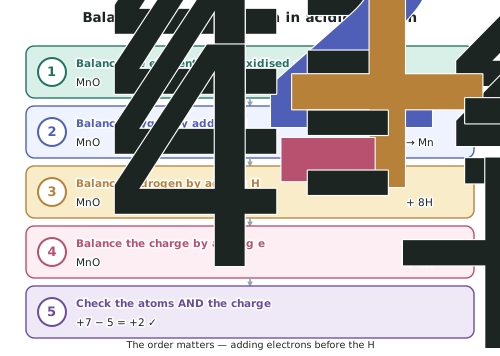
- The order matters. If you add electrons before the H+, you will get the wrong number every time.
Worked through: the permanganate half equation
This is the one you will use most, so learn the process on it.
Step 1 — balance manganese. One Mn on each side already:
Step 2 — balance oxygen. Four O on the left, none on the right, so add 4H2O to the right:
Step 3 — balance hydrogen. Eight H on the right now, none on the left, so add 8H+ to the left:
Step 4 — balance charge. Left is ; right is . The left is more positive by 5, so add 5e− to the left:
Step 5 — check. Mn: 1 = 1. O: 4 = 4. H: 8 = 8. Charge: on the left, on the right. Correct.
- The 5 electrons agree with the oxidation-number change: Mn goes from +7 to +2, a fall of 5.
The half equations worth knowing
You can derive all of these with the five steps, but knowing them saves time:
| Species | Half equation | Electrons |
|---|---|---|
| Permanganate in acid | 5 | |
| Dichromate in acid | 6 | |
| Peroxide as oxidant | 2 | |
| Peroxide as reductant | 2 | |
| Iodate in acid | 10 | |
| Hypochlorite in acid | 2 | |
| Concentrated nitric acid | 1 | |
| Sulfite oxidised | 2 | |
| Sulfur dioxide oxidised | 2 | |
| Hydrogen sulfide oxidised | 2 |
- Notice that the oxidation half equations put H+ on the right — the same five steps, run on a species that is gaining oxygen from water rather than losing it.
Worked ExampleBalancing the dichromate half equation
Ethanol is oxidised by acidified potassium dichromate. Balance the half equation for the reduction of the dichromate ion, Cr2O72−, to Cr3+ in acidic solution.
Step 1 — Balance the element being reduced
There are two chromium atoms in Cr2O72−, so two Cr3+ ions are needed:
Step 2 — Balance the oxygen with water
There are seven oxygen atoms on the left and none on the right, so add 7H2O to the right:
Step 3 — Balance the hydrogen with H+
Seven water molecules contain 14 hydrogen atoms, so add 14H+ to the left:
Step 4 — Balance the charge with electrons
Left: . Right: .
The left is more positive by 6, so add 6e− to the left:
Step 5 — Check
Cr: 2 = 2. O: 7 = 7. H: 14 = 14. Charge: on the left; on the right.
And the electron count agrees with the oxidation numbers: chromium falls from +6 to +3, three electrons each, two chromium atoms, so six electrons.
Answer: Cr2O72−(aq) + 14H+(aq) + 6e− → 2Cr3+(aq) + 7H2O(l)
Worked ExampleBalancing an oxidation half equation
Sulfur dioxide gas dissolves in water and is oxidised to sulfate ions. Balance the half equation in acidic solution.
Step 1 — Balance the element being oxidised
One sulfur on each side:
Step 2 — Balance the oxygen with water
Two oxygen atoms on the left, four on the right, so the left is short by two. Add 2H2O to the left:
Step 3 — Balance the hydrogen with H+
There are now four hydrogen atoms on the left and none on the right, so add 4H+ to the right:
Step 4 — Balance the charge with electrons
Left: 0. Right: .
The right is more positive by 2, so add 2e− to the right:
Step 5 — Check
S: 1 = 1. O: 4 = 4. H: 4 = 4. Charge: 0 on the left; on the right.
The electrons ended up on the right, which is the signature of an oxidation — and sulfur rose from +4 to +6, a loss of two electrons, exactly as the equation shows.
Answer: SO2(g) + 2H2O(l) → SO42−(aq) + 4H+(aq) + 2e−