Tangents and normals to conics
What is being asked
- A tangent touches the curve at one point and has the same gradient as the curve there.
- A normal is perpendicular to the tangent at that point, so
- Both are straight lines, so both answers have the form once you have the gradient and the point.
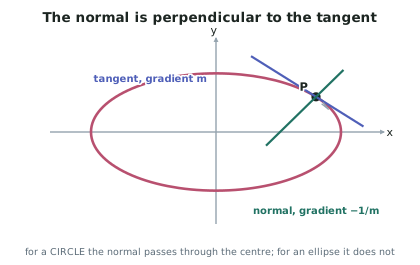
Three routes to the gradient
- Route 1 — geometry (circles only). The tangent is perpendicular to the radius:
- Find the gradient of the radius from the centre to the point.
- Take the negative reciprocal.
- No calculus needed, and it is always the fastest route for a circle.
- Route 2 — the discriminant. Substitute the line into the conic, and impose for tangency.
- Use this when the point of contact is unknown — "find the tangents from an external point", or "for what is this line a tangent?"
- Route 3 — implicit differentiation. Differentiate the conic equation term by term, treating as a function of .
- This belongs to AS91578, but is permitted and often quickest when the point of contact is known.
- Every result on this page is also obtainable by Routes 1 or 2, so the standard can be completed without it.
Route 1 in practice — the circle
- Worked through — the tangent to at :
- Gradient of the radius from to :
- Tangent gradient — the negative reciprocal:
- Equation: , which tidies to
- The normal is the radius itself, extended:
- For a circle the normal always passes through the centre. That is a useful check and often the whole answer.
Route 2 in practice — the discriminant
- Worked through — for what values of is a tangent to ?
- Substitute:
- Multiply by 36 to clear fractions:
- Expand:
- Collect:
- Set :
- , so and
- Two answers, because there are two parallel tangents of any given gradient — one on each side of the ellipse.
- The general condition for to touch is
- Checking: ✓ — the same answer with far less algebra.
Route 3 in practice — implicit differentiation
- Differentiate every term with respect to , and whenever you differentiate a term, multiply by .
- Worked through — the tangent to at :
- Differentiate:
- Rearrange:
- At the point:
- Tangent: , so , or
The standard tangent formulas
- Substituting and in the conic's equation gives the tangent at directly:
| Conic | Tangent at |
|---|---|
- Check the example above: gives , and multiplying by 25 gives ✓
- Use the formula to check, and show the working method in full. An internal wants the reasoning, not just a substitution into a memorised result.
Tangents at a parametric point
- This is where the general results come from. For with , :
- Tangent at parameter :
- Normal at parameter : gradient , giving
- A general point labelled turns a statement about one point into a statement about every point, which is exactly what an Excellence proof needs.
Worked ExampleA tangent and normal on an ellipse
For the ellipse , find the equations of the tangent and the normal at the point , and find where the normal crosses the -axis.
Step 1 — Confirm the point lies on the curve
is on the ellipse, so a tangent there exists.
Step 2 — Find the tangent gradient by implicit differentiation
Differentiate every term with respect to , multiplying by whenever a is differentiated:
Make the subject:
Step 3 — Evaluate at
Sense-check: is in the first quadrant on an ellipse, where the curve is falling as increases — a negative gradient is right ✓
Step 4 — Write the tangent equation
In tidy form, multiplying by 5:
Step 5 — Verify with the standard tangent formula
For an ellipse, the tangent at is :
Multiply by 25:
The two methods agree.
Step 6 — Confirm tangency with the discriminant
Substitute into the ellipse:
Multiply by 225:
Divide by 25:
Step 7 — Find the normal
The normal is perpendicular to the tangent, so its gradient is the negative reciprocal:
Equation through :
Step 8 — Find where the normal crosses the -axis
Set :
Step 9 — Note a property worth observing
Unlike a circle, the normal to an ellipse does NOT pass through the centre. Here it crosses the axis at , not at the origin.
The general result is that the normal at meets the -axis at
Checking: , and ✓