The parabola
What defines a parabola
- A parabola is the set of points that are the same distance from a fixed point (the focus) as from a fixed line (the directrix).
- That definition is what makes parabolas useful. Every ray arriving parallel to the axis reflects off the curve and passes through the focus — which is why satellite dishes, headlight reflectors and solar concentrators are parabolic.
- A parabola is unbounded: it opens out forever, unlike a circle or ellipse.
The two standard forms
- Opening left or right (axis horizontal):
- Opening up or down (axis vertical):
- Each part:
- — the vertex, the turning point of the curve
- — the focal length: the distance from the vertex to the focus, and from the vertex to the directrix
- The squared variable tells you the axis. squared → horizontal axis; squared → vertical axis.
- The sign of gives the direction of opening:
| Form | ||
|---|---|---|
| opens right | opens left | |
| opens up | opens down |
Locating the focus and directrix
- The parabola opens towards the focus and away from the directrix, and the vertex sits exactly halfway between them.
| Form | Vertex | Focus | Directrix |
|---|---|---|---|
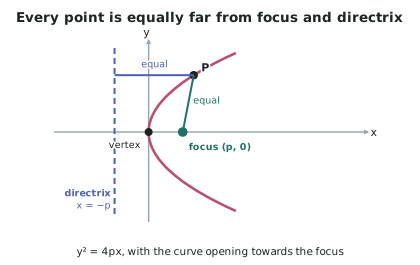
- Worked through — :
- Compare with : , , so
- Vertex , focus , directrix , opening right
The latus rectum
- The latus rectum is the chord through the focus perpendicular to the axis.
- Its length is — exactly the coefficient in the standard form.
- It is the fastest way to sketch the width of the curve. For the parabola is 12 units wide at the focus, so it passes through and .
From the you already know
- The Level 2 form is a parabola with a vertical axis. Completing the square converts it:
- Rearranged into conic form:
- So , giving : vertex , focus , directrix
- The relationship is . A large means a narrow parabola and a focus close to the vertex.
Completing the square on the conic form
- A parabola in general form has only one squared variable:
- Complete the square on the squared variable and make the other one the subject:
- Vertex , so , focus , directrix , opening right
- Only one variable is squared — that is what distinguishes a parabola from the other three conics at a glance.
The reflective property in context
- Every ray parallel to the axis reflects to the focus, and conversely a source at the focus produces a parallel beam.
- In a design problem the useful chain is: given the width and depth of the dish, find , and place the receiver at the focus.
- Worked through — a dish 4 m across and 1 m deep, vertex at the origin opening up:
- The rim is at , so gives , so
- The receiver goes 1 m above the vertex, on the axis.
Worked ExampleDesigning a solar concentrator
A parabolic solar trough has a cross-section 3.6 m wide and 0.9 m deep. Taking the vertex at the origin with the trough opening upwards, find the equation of the cross-section, the position of the collector pipe, and the width of the trough at the height of the pipe.
Step 1 — Set up the model
The trough opens upwards with vertex at the origin, so the form is
with and the focus at .
Step 2 — Use the dimensions to find a point on the curve
The trough is 3.6 m wide in total, so it extends 1.8 m each side of the axis, and it is 0.9 m deep.
Halving the width is the step that gets missed. The 3.6 m spans from to .
Step 3 — Substitute to find
Step 4 — State the equation
Check the rim: and ✓
Step 5 — Locate the collector pipe
The pipe must sit at the focus, so that every ray arriving parallel to the axis is reflected onto it:
Step 6 — Find the width at the height of the pipe
The width at the focus is the latus rectum, whose length is :
Confirming directly. At :
so the trough spans from to , a width of 3.6 m ✓
Step 7 — Interpret and check the design
The design consequence. With the pipe at rim level:
- Every ray entering parallel to the axis reaches the pipe ✓
- The pipe is not shaded by the trough walls, since nothing rises above it
- The supporting structure can rest on the rim rather than reaching out over the aperture
A design check. If the trough were made deeper without widening it — say 1.2 m deep, keeping 3.6 m wide — the rim would be at , giving and . The focus would then sit 0.675 m up, well below the 1.2 m rim, and the pipe would be recessed inside the trough — shading part of the aperture and losing efficiency. Deeper is not better for a parabolic collector, and the equation is what shows it.