The ellipse
What defines an ellipse
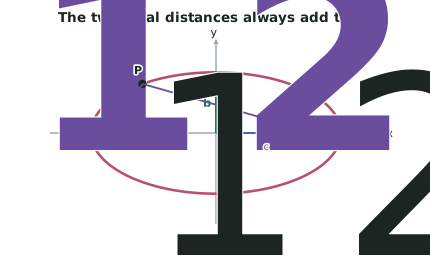
- An ellipse is the set of points whose distances to two fixed points (the foci) add to a constant.
- The gardener's construction makes this concrete: pin the two ends of a loose string, pull it taut with a pencil, and the pencil traces an ellipse.
- It is a closed, bounded curve — unlike the parabola and hyperbola, which run off to infinity.
- A circle is the special case where the two foci coincide at the centre.
The standard equation
- Each part:
- — the centre
- — the distance from the centre to the curve along the -direction (the semi-axis in )
- — the distance from the centre to the curve along the -direction
- The right-hand side must be 1. If it is not, divide the whole equation through before reading anything off.
- The plus sign identifies the ellipse. With a minus it would be a hyperbola; with it is a circle.
Major and minor axes
- The major axis is the longer one, along the direction of the larger denominator. The minor axis is the shorter one.
- The endpoints of the major axis are the vertices; the endpoints of the minor axis are the co-vertices.
- Full lengths are and — the values and themselves are only half-axes.
- The larger denominator tells you the orientation:
- → the ellipse is wider than it is tall; major axis horizontal
- → taller than wide; major axis vertical
The foci
- The foci lie on the major axis, at distance from the centre, where
- For a horizontal major axis (): , foci at .
- For a vertical major axis (): , foci at .
- Subtract, and always the smaller from the larger. A negative means you have subtracted the wrong way round.
- The constant sum of distances is the semi-major axis. For a horizontal ellipse, every point on the curve satisfies .
Eccentricity
- Eccentricity measures how "squashed" an ellipse is:
- — a circle, with both foci at the centre.
- close to 1 — a long, thin ellipse with the foci near the ends.
- Earth's orbit has , which is why it is very nearly circular; Halley's Comet has .
Completing the square for an ellipse
- The general form has both variables squared with the same sign but different coefficients:
- The steps:
- Group the terms and the terms.
- Factor out the coefficient of each squared term before completing the square.
- Complete the square inside each bracket, and add the correct amount — multiplied by the factor outside — to the right-hand side.
- Divide through to make the right-hand side 1.
- Worked through:
- Divide by 225:
- Centre , , , major axis horizontal
- The factor outside multiplies what you add to the right. Adding 1 inside a bracket multiplied by 9 adds 9 to the equation, not 1. This is the single biggest source of error in the topic.
The reflective property
- A ray from one focus reflects off the ellipse and passes through the other focus.
- This is why a whispering gallery works: a whisper at one focus is heard clearly at the other, however large the room.
- It is also the principle behind lithotripsy, where shock waves generated at one focus are concentrated on a kidney stone placed at the other.
Worked ExampleAn elliptical whispering gallery
The ceiling of a gallery is a semi-ellipse. The room is 40 m long and the ceiling is 12 m high at its centre, with the floor as the major axis. Find the equation of the ellipse, the positions of the two "whispering spots", and the ceiling height directly above one of them.
Step 1 — Set up axes
Place the centre of the floor at the origin, with the floor along the -axis.
- The room is 40 m long, so the ellipse extends 20 m each side: the semi-major axis is .
- The ceiling reaches 12 m at the centre, so the semi-minor axis is .
Step 2 — Write the equation
Only the upper half () is the ceiling, since the floor is the major axis.
Check a known point: at , gives — the ceiling meets the floor at the ends of the room ✓ And at , ✓
Step 3 — Identify the orientation
so the major axis is horizontal, along the floor, and the foci lie on the floor.
Step 4 — Find
Subtract the smaller from the larger — would give a negative and no real foci.
Step 5 — Locate the whispering spots
The foci are at :
Why they work: every sound ray leaving reflects off the ceiling and arrives at , and because every such path has the same total length m, all the reflections arrive in phase and reinforce one another.
Step 6 — Find the ceiling height above a focus
Substitute into the equation:
Step 7 — Check with the focal property
The semi-latus rectum of an ellipse — the height above a focus — is :
The two methods agree.
Step 8 — Verify the defining property at a sample point
Take the top of the ceiling, . Its distances to the two foci:
Sum ✓ — exactly the constant the definition requires.
Step 9 — Report the design
Its eccentricity is — a distinctly elongated ellipse, which is what puts the foci far enough apart for the effect to be striking rather than merely a room with an echo.