The circle
Where the conics come from
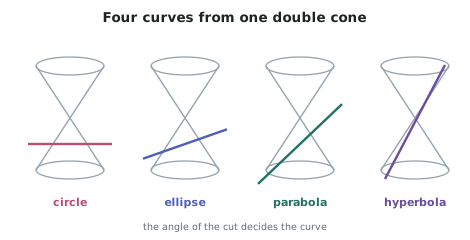
- A conic section is the curve formed when a plane slices a double cone.
- The angle of the slice decides which curve you get:
- Perpendicular to the axis → circle
- Tilted, but less steeply than the slope of the cone → ellipse
- Exactly parallel to the slope of the cone → parabola
- Steeper than the slope, cutting both halves of the cone → hyperbola
- The circle is a special case of the ellipse, with both axes equal — which is why their equations are so similar.
The equation of a circle
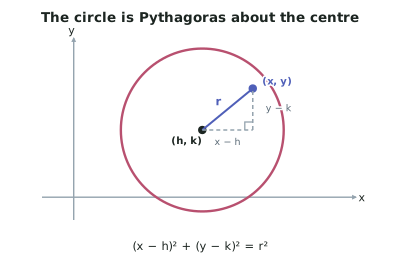
- A circle is the set of points at a fixed distance (the radius) from a fixed point (the centre).
- Applying the distance formula to that definition gives the standard form:
- Each part:
- — the centre
- — the radius, always taken positive
- The signs are subtracted inside the brackets. means , not . This one sign error accounts for most wrong centres.
- Centred at the origin the equation reduces to .
Recognising a circle from the general form
- Expanding the standard form gives the general form:
- Two features identify a circle in this form:
- Both and appear, and
- their coefficients are equal (and there is no term).
- If the coefficients are equal but not 1, divide the whole equation through first. becomes .
Completing the square
- This is the core technique of the entire standard. It converts the general form into the standard form.
- The steps:
- Group the terms together and the terms together, and move the constant to the right.
- Halve the coefficient of , square it, and add it to both sides. Repeat for .
- Factorise each group into a perfect square.
- Read off the centre and radius.
- Worked through — :
- Group:
- Half of is , squared is ; half of is , squared is :
- Centre , radius
- Whatever you add on the left must be added on the right. Forgetting that changes the radius but not the centre, so the answer looks plausible.
When it is not a circle
- After completing the square, the right-hand side may not be a positive number:
- Positive → a genuine circle of radius
- Zero → a single point, sometimes called a degenerate circle
- Negative → no real points at all — the equation has no graph
- Report the degenerate cases rather than taking the square root of a negative.
Intersections with a line
- Substitute the line into the circle and solve the resulting quadratic.
- The discriminant tells you the geometry without solving:
| Meaning | |
|---|---|
| The line is a secant — it cuts the circle twice | |
| The line is a tangent — one point of contact | |
| The line misses the circle |
- The alternative check is often faster: compare the perpendicular distance from the centre to the line with the radius. Less than → cuts; equal → tangent; greater → misses.
Properties worth knowing
- The tangent at any point is perpendicular to the radius drawn to that point. This single fact solves most circle-tangent questions without any calculus.
- The perpendicular from the centre to a chord bisects the chord.
- A circle is the only conic with constant curvature — every point looks the same, which is why circles have no foci to distinguish and no eccentricity to speak of (formally, ).
Worked ExampleA circular sports field
A circular sports field is modelled by , with units in metres. Find its centre and radius, determine whether the straight path crosses the field, and find the points where it meets the boundary.
Step 1 — Confirm it is a circle
Both squared terms are present, their coefficients are equal (both 1), and there is no term — so this is a circle.
Step 2 — Group the terms and move the constant
Step 3 — Complete the square in
Half of is ; squared, that is . Add 25 to both sides:
Step 4 — Complete the square in
Half of is ; squared, that is . Add 4 to both sides:
Step 5 — Factorise and read off
Sense-check: the brackets are zero at and , which is the centre ✓ and 49 is positive, so the circle is genuine ✓
Step 6 — Test whether the path crosses, using the distance from the centre
Write the line in the form :
The perpendicular distance from to this line:
Compare with the radius:
Step 7 — Find the intersection points by substitution
Substitute into the standard form:
Expand both brackets in full:
Collect like terms:
Step 8 — Solve the quadratic
Positive, confirming two intersection points ✓ (agreeing with Step 6)
Step 9 — Find the matching values from the LINE
Step 10 — Check and interpret
Check the first point in the circle:
Length of the path across the field — the distance between the two points: