Cartesian and parametric forms
Two ways to describe the same curve
- A Cartesian equation relates and directly: . It answers "is this point on the curve?"
- Parametric equations give and each in terms of a third variable, the parameter: , . They answer "where is the point when the parameter is ?"
- The parameter usually has a meaning: an angle for a circle or ellipse, time for a moving object, or a position along the curve.
- Both describe exactly the same set of points. Choosing between them is a matter of which question you are answering.
The standard parametric forms
| Conic | Cartesian | Parametric |
|---|---|---|
| Circle radius , centre | , | |
| Ellipse | , | |
| Parabola | , | |
| Hyperbola | , | |
| Rectangular hyperbola | , |
- Notice the pattern. The trigonometric forms rely on an identity: for the ellipse, and for the hyperbola. The identity is what makes the substitution work.
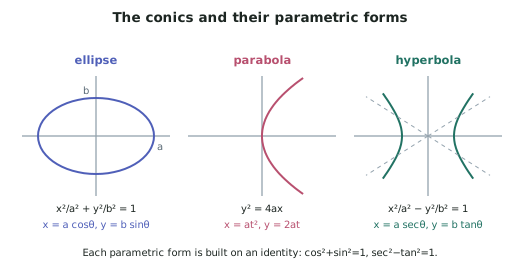
- Sketch the curve before you start manipulating it. Knowing which of these three shapes you are dealing with tells you immediately what a sensible answer looks like — an ellipse is bounded, a parabola and a hyperbola are not, and a hyperbola has two separate branches that a single point cannot bridge.
Converting parametric to Cartesian — eliminate the parameter
-
The goal is to remove or entirely, leaving a relationship between and alone.
-
Three standard techniques:
- Rearrange and substitute — make the parameter the subject of one equation and put it into the other. Works whenever the parameter appears algebraically.
- Use a trigonometric identity — isolate and , then use .
- Multiply or divide the two equations — especially effective for , , where multiplying gives in one step.
-
Worked through — , :
- Isolate: and
- Apply the identity:
- — an ellipse with a vertical major axis
-
Worked through — , :
- From the second,
- Substitute:
- — a parabola with , so ✓ matching the form ,
Converting Cartesian to parametric
- Match the equation to a standard form and read off the parameters.
- The choice is not unique. can be written , , or , — both trace the same parabola. Any valid parametrisation is acceptable unless the question asks for a particular one.
- State the range of the parameter when it matters. , traces the whole circle for ; restricting to gives only the upper semicircle.
Restrictions the parametric form imposes
- Parametric forms can miss points, and saying so is often the point of the question:
- , is undefined at , where and are undefined.
- , excludes , so the curve never touches either axis — correctly, since .
- is never negative, so this parametrisation covers only the right-opening parabola.
- Check the domain and range your parametrisation produces, and compare it with the Cartesian curve.
Why parametric forms are worth having
- They handle vertical tangents naturally. At the top of a circle, is undefined in Cartesian terms, but the parametric description is perfectly well behaved.
- They give each point a label. "The point with parameter " is a single symbol that stands for a general point, which is exactly what a proof about every point needs.
- They describe motion. With as time, the parametric equations give position, and their derivatives give velocity.
- Tangent equations become formulas in the parameter, which is how the standard's general tangent results are derived.
Worked ExampleMoving between the two forms
A point moves so that its position at time seconds is , metres, for .
(a) Find the Cartesian equation of its path and name the curve. (b) Find where the point is at and , and the straight-line distance between those positions. (c) Explain why the point never crosses either axis.
Step 1 — Part (a): eliminate the parameter
The quickest route here is to multiply the two equations, because appears once in the numerator and once in the denominator:
The cancels completely — no rearranging or substituting needed.
Step 2 — Name the curve
Confirming by the alternative route. From we get , and substituting into :
Step 3 — Part (b): find the two positions
At :
At :
Check both lie on the curve: ✓ and ✓
Step 4 — Find the distance between them
Step 5 — Part (c): explain why the axes are never crossed
From the parametric form. Reaching the -axis requires :
but is excluded, because is undefined there. Reaching the -axis requires :
which has no solution at all — a fraction with a non-zero numerator is never zero.
From the Cartesian form. If then , and likewise for .
Step 6 — Interpret the motion
As the point is far up the -axis (, ); as it runs far out along the -axis (, ).
This is the classic inverse relationship: says the product of the two coordinates is constant, so as one grows the other must shrink in exact proportion — the same structure as Boyle's law, where doubling the pressure halves the volume.