The hyperbola
What defines a hyperbola
- A hyperbola is the set of points whose distances to two fixed points (the foci) DIFFER by a constant.
- Compare with the ellipse: the ellipse adds the two distances, the hyperbola subtracts them. That one change turns a closed oval into two separate open branches.
- Practical uses: long-range navigation systems locate a ship by the difference in arrival times of two signals, which places it on a hyperbola; cooling towers are hyperbolic in profile; a comet with too much energy to be captured follows a hyperbolic path.
The standard equation
- The minus sign identifies the hyperbola.
- The POSITIVE term tells you which way it opens — not the size of the denominators. This is the key difference from the ellipse, where the larger denominator decides.
- term positive → branches open left and right, vertices on a horizontal line
- term positive → branches open up and down
- is the centre, which is not on the curve — it is the midpoint between the two branches.
Vertices and asymptotes
- The vertices are the two points where the branches are closest together, at distance from the centre along the opening direction (for the -positive form): .
- The asymptotes are the two straight lines the branches approach but never touch:
- How to find them reliably: replace the 1 on the right-hand side with 0 and solve:
- This works for both orientations and removes any need to memorise which of and goes on top.
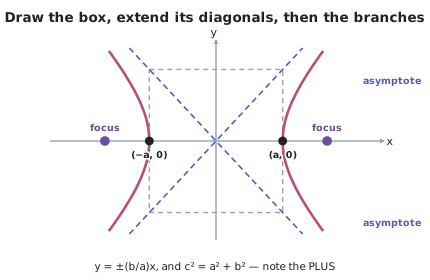
- Sketching method — draw the box. Mark horizontally and vertically from the centre, draw the rectangle, extend its diagonals as the asymptotes, then draw each branch through its vertex hugging the asymptotes.
The foci
- Note the ADDITION. For an ellipse it was a subtraction; for a hyperbola the foci lie beyond the vertices, so always.
- The foci sit on the same axis as the vertices, at for the -positive form.
- Eccentricity is again , but now for every hyperbola.
| Conic | Focal relationship | Eccentricity |
|---|---|---|
| Circle | foci coincide | |
| Ellipse | ||
| Parabola | — | |
| Hyperbola |
The rectangular hyperbola
- When the asymptotes are perpendicular, and the hyperbola is called rectangular.
- Rotated to sit against the axes, the rectangular hyperbola has the familiar form
- Its asymptotes are the coordinate axes themselves.
- This is the shape of an inverse relationship — Boyle's law , and any "constant product" context.
- The vertices of are at and , on the line .
Completing the square for a hyperbola
- The general form has both squared terms with OPPOSITE signs:
- The procedure is the same as for an ellipse, but watch the negative factor:
- Divide by 144:
- Centre , , , opening left and right; asymptotes
- Adding 9 inside a bracket multiplied by SUBTRACTS 81 from the equation. Getting that sign wrong is the most common error on this page.
Worked ExampleA navigation fix
Two radio beacons stand 200 km apart on a straight coastline, at and with distances in kilometres. A ship receives the signal from the eastern beacon seconds before the one from the western beacon. Radio waves travel at km/s. Find the equation of the curve on which the ship must lie, and its closest possible approach to the coastline's midpoint.
Step 1 — Turn the time difference into a distance difference
Step 2 — Recognise the conic
A constant difference of distances to two fixed points is exactly the definition of a hyperbola, with the two beacons as its foci.
Because the ship is nearer the eastern beacon, it lies on the eastern branch.
Step 3 — Identify from the constant difference
For a hyperbola, the constant difference of focal distances equals :
Step 4 — Identify from the beacon positions
The foci are at , so
Check : ✓ as every hyperbola requires.
Step 5 — Find
Step 6 — Write the equation
The foci are on the -axis, so the term is positive:
Step 7 — Find the closest approach to the midpoint
The midpoint of the coastline is the centre of the hyperbola, . The nearest point of the eastern branch to the centre is its vertex:
Verify with the defining property at the vertex. Distances from to the two foci:
- To the eastern focus : km
- To the western focus : km
Exactly the measured difference, confirming the whole calculation.
Step 8 — Describe where the ship might be, far out to sea
As the ship moves far from the coast, its position approaches the asymptotes:
Step 9 — Report the fix
One measurement is not a position. A second pair of beacons would give a second hyperbola, and the intersection of the two curves fixes the ship's location — which is exactly how hyperbolic navigation systems work.