Unicellular organisms
A unicellular organism is a whole organism made of one cell. That one cell has to do every job an organism does — move, feed, get rid of waste, respond to its surroundings and reproduce — so its features are packed into a single cell instead of shared between tissues.
Where to find one
- Pond water from a still, weedy pond or a slow stream is the usual source. Take some water together with a little sediment and weed, where the organisms concentrate.
- A hay infusion — hay or grass left in water for a week — grows large numbers of them.
- Yeast is a unicellular fungus, easy to get and easy to view, and it shows budding clearly.
- Use a cavity slide. Living organisms swim, and a flat wet mount squashes them.
Three you are likely to see
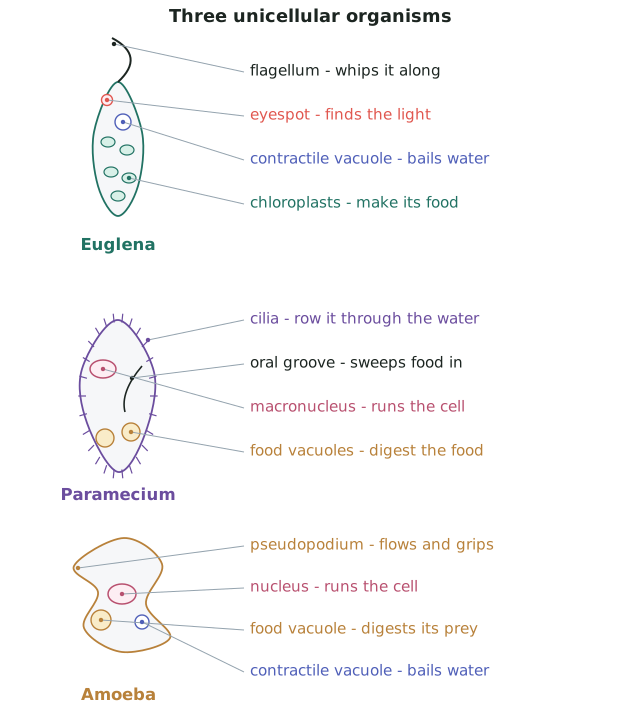
Euglena — a green, spindle-shaped swimmer.
- Flagellum — one long whip at the front end, which lashes to pull the cell through the water.
- Eyespot — an orange-red spot near the front, which shades a light-sensitive area so the cell can tell which direction light is coming from and swim towards it.
- Chloroplasts — green discs through the cell, so it can make its own food in the light.
- Contractile vacuole — a clear round space near the front, which fills with water and empties it out of the cell.
- Pellicle — a flexible protein layer instead of a rigid wall, so the cell can change shape and squeeze through gaps.
Paramecium — a large slipper-shaped cell covered in fine hairs.
- Cilia — thousands of short hairs covering the surface, beating together to row the cell along and to sweep food towards it.
- Oral groove — a channel in one side lined with cilia, down which food particles are swept into the cell.
- Food vacuoles — round bodies inside the cell where food is digested.
- Contractile vacuoles — usually two, which collect water and expel it.
- Macronucleus — a large nucleus controlling the cell's day-to-day work, with a smaller micronucleus beside it.
Amoeba — a colourless cell with no fixed shape.
- Pseudopodia — "false feet", blunt extensions of the cell that flow forward and pull the rest after them.
- Food vacuole — formed when pseudopodia flow around a food particle and enclose it.
- Contractile vacuole — a clear space that swells and then empties.
- Nucleus — a single rounded nucleus, often hard to see without stain.
What they have in common
- Every one has a way of moving — a flagellum, cilia, or flowing pseudopodia. A unicellular organism that cannot move cannot reach food or leave bad conditions.
- Every one has a way of taking food in across its own surface, since there is no mouth or gut.
- All three live in fresh water, and all three have a contractile vacuole. Fresh water is more dilute than the cell contents, so water constantly enters by osmosis; without something pumping it back out, the cell would swell and burst.
Viewing them without losing them
- Slow them down. A drop of methyl cellulose thickens the water so the organism swims slowly enough to draw. A few strands of cotton wool in the drop tangle it in one place.
- Turn the light down with the diaphragm. Most of these organisms are nearly transparent, and too much light washes them out completely.
- Find them on low power first. At ×400 you are looking at a tiny patch of the drop, and a swimming organism crosses it in a moment.