Plant cells and plant tissues
A tissue is a group of similar cells that work together on one job. Two different plant tissues look different down the microscope because the cells in them are built for different jobs — and those differences are what you are looking for.
What is visible in a plant cell
- Cell wall — a rigid box outside the cell, seen as the clear line between one cell and the next. It is the most obvious thing in any plant mount.
- Cytoplasm — a thin layer inside the wall, usually pressed against it by the vacuole.
- Nucleus — a rounded body, invisible until stained, then dark against the paler cytoplasm.
- Large central vacuole — a fluid-filled space taking up most of the middle of the cell. It shows as an empty clear area, not as a drawn organelle.
- Chloroplasts — small green discs, in cells from parts of the plant that receive light. They need no stain.
- Starch grains — small oval grains, invisible until iodine turns them blue-black.
Onion bulb epidermis
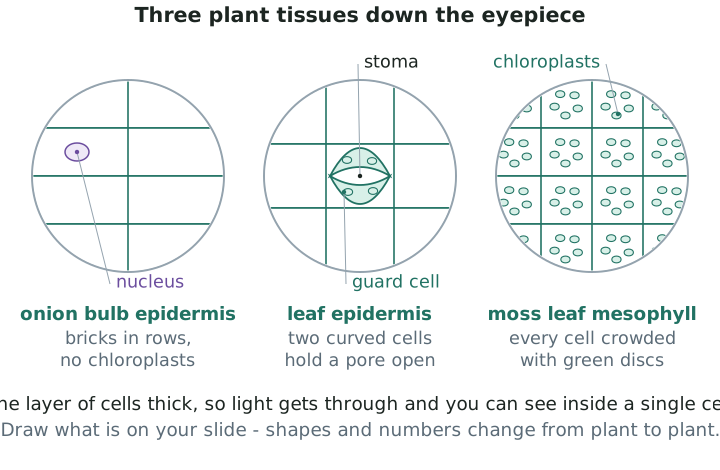
- Arrangement — long brick-shaped cells packed in rows with no spaces, like a wall of bricks. The rows are neat but not perfectly regular.
- Shape — several times longer than wide, with straight walls and squared-off ends.
- No chloroplasts at all. An onion bulb is an underground storage organ, so its cells never receive light and would gain nothing from chloroplasts.
- A nucleus in each living cell, visible once stained, usually pressed against the side wall by the vacuole.
- The job of the tissue is to cover and protect the fleshy storage leaf underneath.
Leaf epidermis, and guard cells
- Arrangement — a single sheet of cells covering the leaf surface, interrupted at intervals by stomata.
- Epidermal cells are flat, irregular in outline, tightly interlocked, and have no chloroplasts.
- A stoma is a pore, and each one is enclosed by two guard cells.
- Guard cells are the exception in the epidermis: they are curved, sausage-shaped, and they do contain chloroplasts.
- The job of the tissue is to cover the leaf and control what passes in and out through the stomata.
Mesophyll — the photosynthetic tissue
- Palisade mesophyll sits just under the upper surface. The cells are column-shaped, stand upright, are packed closely side by side, and are crammed with chloroplasts.
- Spongy mesophyll sits below it. The cells are irregular and loosely packed, with large air spaces between them, and have fewer chloroplasts.
- A moss leaf is often used instead of a sectioned leaf, because it is naturally one or two cells thick and every cell is full of chloroplasts.
- The job of the tissue is photosynthesis, and in the spongy layer, letting gases move.
Two more tissues you may be given
- Vascular tissue in a celery stalk — the "strings" are bundles containing xylem vessels: long, hollow, dead tubes with no cytoplasm and thickened walls, seen end to end as parallel lines. Their job is to carry water up the plant.
- Storage parenchyma in a potato — large, thin-walled, roughly round cells, each packed with starch grains that iodine turns blue-black. Their job is to store the products of photosynthesis.