Momentum and impulse in two dimensions
Key ideas
- Momentum is a vector: , pointing the same way as the velocity. Its unit is kg m s⁻¹.
- Conservation of momentum still holds when there is no external force — but in two dimensions you must conserve it as a vector.
- The reliable method is to split momentum into components:
- conserve the -component of total momentum:
- conserve the -component of total momentum:
- Impulse is the change in momentum, and equals force × time:
- Impulse is also a vector — a sideways force changes the sideways momentum only.
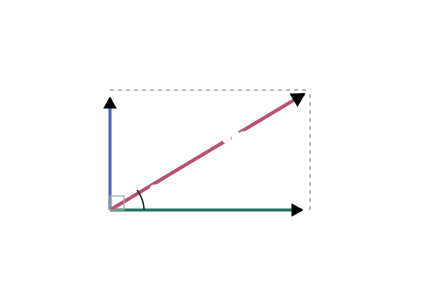
Method for a 2D collision
- Draw a vector diagram of the momenta before and after.
- Resolve every momentum into - and -components.
- Equate total before = total after, separately for and .
- Recombine the final components with Pythagoras and trigonometry to get the final speed and direction.
A kg car moving east at m s⁻¹ collides with a kg car moving north at m s⁻¹. They lock together. Find their common velocity just after impact.
Step 1 — Momentum components before (no external force during the impact)
East (): kg m s⁻¹ North (): kg m s⁻¹
Step 2 — Total momentum (Pythagoras)
Step 3 — Common velocity (they share the total mass)
Step 4 — Direction
Tips
- Resolve into components before doing anything else. Trying to add momentum vectors by their magnitudes alone is the classic 2D-momentum mistake — a north momentum and an east momentum do not add to give their arithmetic sum.
- Check your angle is measured from the axis you claim ("north of east" vs "east of north") — a protractor mark on your vector diagram earns method marks even if the arithmetic slips.
Test yourself
Practice by grade
One question each at Achieved, Merit and Excellence. Have a go, then compare with the model answer.
Achieved
A kg ball moving east at m s⁻¹ is struck and moves north at m s⁻¹.
Show that the magnitude of its change in momentum is kg m s⁻¹.
Merit
A kg trolley moving east at m s⁻¹ collides with a stationary kg trolley and they stick together.
Calculate their common speed.
Excellence
A kg object at rest explodes into two pieces. A kg piece flies east at m s⁻¹.
Determine the velocity of the kg piece, and explain why kinetic energy is not conserved here.