Gravitation and satellite motion
Key ideas
- Newton's law of universal gravitation — every mass attracts every other mass:
- Each variable, with sub-bullets:
- — the gravitational constant, N m² kg⁻² (given in the exam)
- — the two masses (kg)
- — the distance between their centres (m), not their surfaces
- The force follows an inverse-square law: triple the separation and the force drops to a ninth.
Satellites in circular orbit
- For a satellite, gravity provides the centripetal force. Setting them equal:
- The satellite mass cancels, giving the orbital speed:
- A larger orbit () means a slower speed and a longer period. The period follows from .
- A geostationary satellite has a period of exactly one day, so it stays above the same point on the equator.
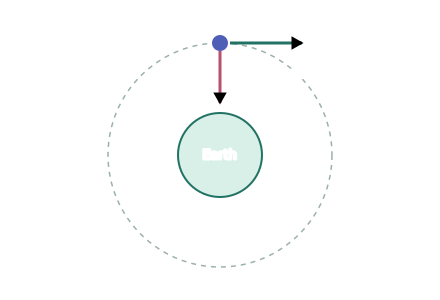
A satellite orbits Earth at an altitude of km. Earth's mass is kg and its radius is m. Find the orbital speed and period.
Step 1 — Orbital radius is measured from Earth's centre
Step 2 — Orbital speed (gravity = centripetal force)
Step 3 — Period from the circumference
Tips
- Always work with the distance from the centre. Add the planet's radius to the altitude; using the altitude alone is the most common gravitation error.
- Keep every value unrounded on your calculator until the final line — the inverse-square and square-root steps magnify early rounding badly.
Test yourself
Practice by grade
One question each at Achieved, Merit and Excellence. Have a go, then compare with the model answer.
Achieved
Two kg masses are m apart (centre to centre).
Show that the gravitational force between them is about N. ( N m² kg⁻².)
Merit
A satellite orbits a planet of mass kg at a radius of m.
Calculate its orbital speed. ( N m² kg⁻².)
Excellence
Explain why a geostationary satellite must orbit at one particular radius, and why it can only sit above the equator.