Pendulums, springs, energy and resonance
Key ideas
- Two systems in the course oscillate in SHM, each with its own period:
- Simple pendulum (small swings):
- — the length of the pendulum (m)
- the period does not depend on the mass or the amplitude (for small swings)
- Mass on a spring:
- — the mass (kg)
- — the spring constant (N m⁻¹)
- Simple pendulum (small swings):
- Energy in SHM continuously swaps between kinetic and potential, but the total stays constant (with no friction):
- all kinetic at the centre (maximum speed)
- all potential at the ends (momentarily at rest)
- total energy — doubling the amplitude quadruples the energy.
Damping, driving and resonance
- Damping — a resistive force (friction, air resistance) removes energy, so the amplitude decays over time. The period is barely changed for light damping.
- Free oscillation happens at the system's own natural frequency .
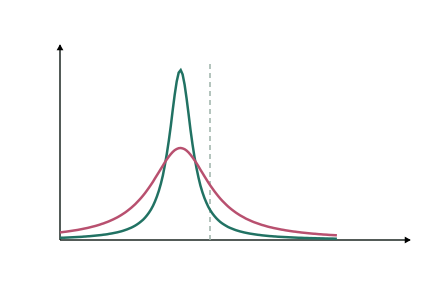
- Driven (forced) oscillation — an external periodic push. When the driving frequency matches the natural frequency, the amplitude grows very large: this is resonance.
- More damping gives a lower, broader resonance peak. Engineers add damping (car suspension, tall buildings) precisely to limit resonance.
Find the length of a simple pendulum whose period is exactly s (a "seconds pendulum"). Take m s⁻².
Step 1 — Start from the pendulum period
Step 2 — Rearrange for the length
Step 3 — Substitute (keep unrounded values)
Tips
- Match the period formula to the system: for a pendulum, for a spring. Notice the mass helps a pendulum not at all but slows a spring — a favourite Excellence discriminator.
- For resonance questions, always name the two frequencies you are comparing (driving vs natural) and state that they are equal at resonance; a vague "the frequencies match" often misses the mark.
Test yourself
Practice by grade
One question each at Achieved, Merit and Excellence. Have a go, then compare with the model answer.
Achieved
A kg mass on a spring of constant N m⁻¹ oscillates in SHM.
Show that its period is about s.
Merit
A pendulum has length m. Take m s⁻².
Calculate its period, and state what would happen to the period if a heavier bob were used.
Excellence
Soldiers are told to break step when crossing a footbridge.
Explain, using natural frequency, resonance and damping, why marching in step could be dangerous.