Circular motion and centripetal force
Key ideas
- An object moving in a circle at constant speed is still accelerating, because its direction keeps changing.
- This centripetal acceleration always points toward the centre of the circle:
- The acceleration needs a net inward force, the centripetal force:
- Each variable, with sub-bullets:
- — the speed around the circle (m s⁻¹)
- — the radius of the circle (m)
- — the angular velocity (rad s⁻¹), where
- Centripetal force is not a new force. It is the name for the net inward force, provided by real forces — tension, gravity, friction, the normal force, or a combination.
- For one trip around, , where is the period.
Objects under two or more forces
At Level 3 the inward force is usually the resultant of two forces. Three classic set-ups:
- Conical pendulum — a mass swung in a horizontal circle on a string. The string tension and gravity combine; the horizontal part of the tension is the centripetal force:
- vertical:
- horizontal:
- Banked corner (no friction) — the road is tilted so the horizontal part of the normal force turns the car:
- Vertical circle — at the top, gravity and the normal (or tension) both point down toward the centre, so . The slowest speed that keeps contact is when : .
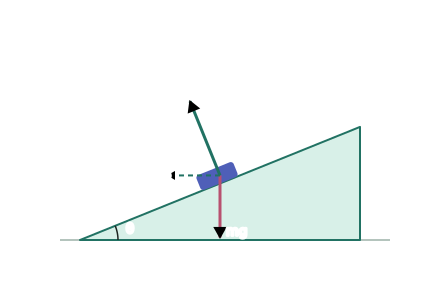
A motorway corner of radius m is banked at . Find the speed at which a car can round it with no sideways friction.
Step 1 — Choose the frictionless banking relationship
With no friction, only the normal force and gravity act, giving .
Step 2 — Rearrange for
Step 3 — Evaluate (keep unrounded values until the end)
Tips
- Never add a separate "centripetal force" to a free-body diagram. Draw only the real forces (tension, weight, normal, friction), then set their resultant toward the centre equal to . Adding as an extra arrow double-counts it.
- Keep angles in the mode your calculator expects, and remember lets you swap between speed and angular velocity whenever a question mixes them.
Test yourself
Practice by grade
One question each at Achieved, Merit and Excellence. Have a go, then compare with the model answer.
A kg ball on a string moves in a horizontal circle of radius m at m s⁻¹.
Show that the centripetal force is N.
A car of mass kg rounds a flat (unbanked) corner of radius m at m s⁻¹.
Calculate the friction force needed, and state what provides the centripetal force.
A bucket of water of mass kg is swung in a vertical circle of radius m.
Determine the minimum speed at the top for the water to stay in the bucket, and explain what happens to the normal (contact) force at that speed.