Simple harmonic motion
Key ideas
- Simple harmonic motion (SHM) is the back-and-forth motion where the acceleration is proportional to the displacement and always points back toward the centre:
- The minus sign is the whole idea: it is a restoring acceleration — the further out the object, the harder it is pulled back. This condition defines SHM.
- Each variable, with sub-bullets:
- — displacement from the equilibrium (centre) position (m)
- — the angular frequency (rad s⁻¹), where
- — the amplitude, the maximum displacement (m)
- Starting from the centre, displacement, velocity and acceleration vary with time as:
- (If the object starts at the end of its swing instead, swap and : .)
- The maximum speed is (at the centre), and the maximum acceleration is (at the ends).
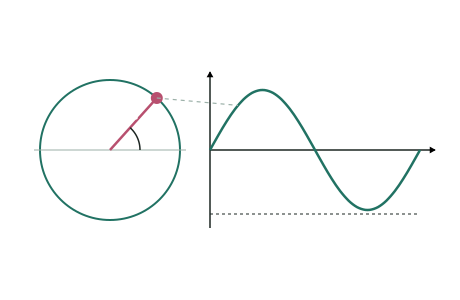
The reference circle and phasors
- SHM is the shadow (projection) of uniform circular motion. A point going around a circle of radius at angular velocity casts a shadow that moves in SHM.
- This is why SHM uses and why and — they are the rim speed and centripetal acceleration of that reference circle.
- A phasor is the rotating arrow itself; its angle gives the phase of the motion.
A mass oscillates in SHM with amplitude m and angular frequency rad s⁻¹. Find its maximum speed and maximum acceleration.
Step 1 — Maximum speed (at the centre)
Step 2 — Maximum acceleration (at the ends of the swing)
Tips
- is angular frequency, not frequency. Convert with before substituting; using in place of is the most common SHM slip.
- Decide where the object starts: at the centre use , at the end use . Getting this wrong flips your whole graph.
Test yourself
Practice by grade
One question each at Achieved, Merit and Excellence. Have a go, then compare with the model answer.
Achieved
An object in SHM has amplitude m and angular frequency rad s⁻¹.
Show that its maximum speed is m s⁻¹.
Merit
An object oscillates in SHM with a period of s and amplitude m.
Calculate its maximum acceleration.
Excellence
An object in SHM has amplitude m and angular frequency rad s⁻¹.
Determine its speed when it is m from the centre, and explain why the acceleration there is exactly half its maximum value.