The Thomson and Rutherford models of the atom
Why the atom is described with models
Nobody has ever seen an atom directly. Everything we say about atomic structure comes from models — pictures of the atom built to explain experimental evidence, and replaced when new evidence contradicts them.
- A model in physics is a simplified description that makes predictions you can test.
- A model is not "true" or "false" — it is useful until an experiment produces a result it cannot explain.
- Two models matter for this standard: Thomson's (1904) and Rutherford's (1911).
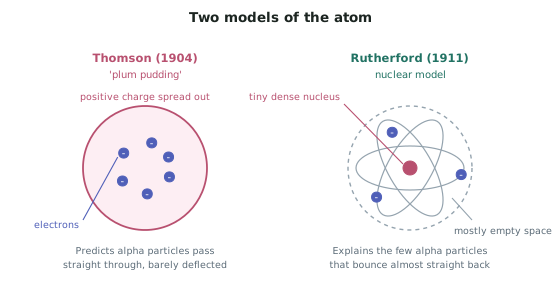
Thomson's model (the 'plum pudding' model)
- Thomson had discovered the electron — a tiny, negatively charged particle much lighter than an atom.
- Atoms are neutral, so he reasoned there must be positive charge somewhere to balance the electrons.
- His model: a sphere of positive charge spread evenly through the whole atom, with electrons embedded in it like plums in a pudding.
- The positive charge is spread out, not concentrated.
- The mass of the atom is spread evenly through its volume.
- Prediction: a fast, heavy, positively charged particle fired at a thin sheet of atoms should pass almost straight through, deflected only very slightly — because nowhere in the atom is there a concentrated charge or mass strong enough to turn it sharply.
Rutherford's model (the nuclear model)
- Rutherford's model was forced on him by the gold foil experiment (next page), which produced deflections Thomson's model could not explain.
- His model: almost all the mass and all the positive charge sit in an extremely small nucleus at the centre; the electrons orbit far outside it, and the atom is mostly empty space.
- The nucleus is roughly 10 000 times smaller in radius than the atom itself.
- Because the charge is concentrated, the electric force close to the nucleus is enormous — enough to turn an alpha particle right around.
- What it explains: most alpha particles pass through undeflected (they never come near a nucleus), while a very small number come close enough to be pushed through a huge angle.
Comparing the two models
| Feature | Thomson | Rutherford |
|---|---|---|
| Positive charge | spread evenly through the atom | concentrated in a tiny nucleus |
| Mass | spread evenly through the atom | almost all in the nucleus |
| Electrons | embedded in the positive sphere | orbiting outside, far from the nucleus |
| Most of the atom | filled with matter | empty space |
| Predicts large-angle scattering? | No | Yes |
Deflection θ = 46° — a large deflection — this alpha passed close to the nucleus.
- Notice what the widget shows: the deflection depends only on how close the alpha particle's path passes to the nucleus. Aim far away and it barely bends; aim almost dead-on and it comes straight back.
- This is exactly why only a tiny fraction of alpha particles bounce back — almost none of them are aimed close enough.
How a scientific model gets replaced
The sequence here is the standard pattern of science, and questions often ask you to describe it:
-
A model is proposed that explains the evidence available at the time. Thomson's model accounted for the existence of electrons and for the atom being electrically neutral.
-
The model is used to make a prediction about an experiment not yet done — here, that alpha particles would pass through gold foil barely deflected.
-
The experiment is performed. Most alpha particles behaved as predicted, but a very small number were deflected through large angles, and some came almost straight back.
-
The prediction fails, so the model must be modified or replaced — not the evidence.
-
A new model is proposed that explains both the old evidence and the new. Rutherford's nuclear atom explains the electrons, the neutrality, the mostly-undeflected majority, and the rare large deflections.
-
Note that Thomson's model was not "wrong" in a careless sense — it was the best explanation of the evidence available. It was replaced because new evidence appeared that it could not account for. That is how scientific models are expected to behave.
Worked ExampleReasoning from a result to a model
In an alpha-scattering experiment, about in every alpha particles is deflected through more than . Explain what this single statistic tells you about the structure of the atom, and why it rules out Thomson's model.
Step 1 — What a large deflection requires
Turning a fast, massive, positively charged alpha particle through more than requires a very large repulsive force. Since alpha particles are positive, that force must come from a concentrated positive charge, and it must be strong enough to reverse the particle's momentum.
A large force also requires the alpha particle to come very close to that charge, because electrostatic repulsion grows rapidly as the separation shrinks.
Finally, the object doing the repelling must be much more massive than the alpha particle — otherwise it would simply be knocked aside itself, and the alpha would continue on largely unaffected.
Step 2 — What the rarity tells you
Only in particles is deflected this much, so the region capable of producing such a force must be extremely small compared with the atom — almost every alpha particle passes through the foil without coming anywhere near one.
If the concentrated charge filled a large fraction of each atom, a large fraction of the alpha particles would be strongly deflected. They are not.
Step 3 — Combine the two conclusions
The atom must contain a region that is very small, carries all the positive charge, and holds almost all the mass — a nucleus — with the rest of the atom being mostly empty space that alpha particles cross undisturbed.
Step 4 — Why Thomson's model fails
In Thomson's model the positive charge is spread thinly through the whole atom, so nowhere is it concentrated enough to produce a large force, and its mass is spread out too. The model predicts that every alpha particle passes through with only a slight deflection, and that none should ever come back.
Even a single large-angle deflection contradicts that prediction, and in is far too many to dismiss as experimental error.