The gold foil experiment
The experiment that overturned Thomson's atom
The gold foil experiment (Geiger and Marsden, directed by Rutherford) is the single piece of evidence that replaced Thomson's atom with the nuclear atom.
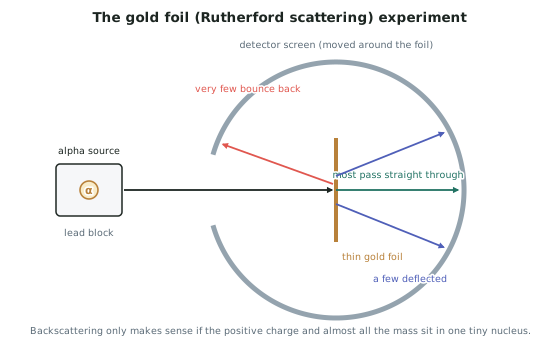
The method
- A radioactive source emitting alpha particles (helium nuclei, charge ) was placed in a lead block with a narrow channel, producing a thin beam in one direction.
- The beam was fired at an extremely thin gold foil — only a few hundred atoms thick, so most alpha particles pass through only a few atoms.
- A detector screen that flashes when struck by an alpha particle was moved around the foil to count particles arriving at different angles.
- The whole apparatus was in a vacuum, so the alpha particles were not absorbed or scattered by air.
The observations
| Observation | How often |
|---|---|
| Passed straight through, undeflected | the vast majority |
| Deflected through small angles | a small number |
| Deflected through more than 90°, some almost straight back | about 1 in 8000 |
What each observation tells you
- Most pass straight through → the atom is mostly empty space. If atoms were solid throughout, every alpha particle would be deflected.
- A few are deflected slightly → they passed reasonably near a concentrated positive charge and were repelled.
- A very few bounce almost straight back → they met something positively charged, very massive and very small. Only a concentrated charge can push a fast alpha particle backwards, and only a mass much greater than the alpha's own mass can do so without being knocked aside itself.
- Rutherford's own comment was that it was as surprising as firing a shell at tissue paper and having it come back at you.
- Because backscattering is so rare, that concentrated region must be extremely small compared with the atom.
Worked ExampleReasoning from an observation to a conclusion
In the gold foil experiment, about 1 in 8000 alpha particles was deflected through an angle greater than 90°. Explain what this specific observation tells us about the atom, and why the rarity of the event matters as much as the event itself.
Step 1 — What a large deflection requires
An alpha particle is positive and fast. To reverse its direction, something must exert a very large repulsive electric force on it. That requires a large positive charge concentrated in a small region, because electric force grows rapidly as the separation shrinks.
Step 2 — Why the deflecting object must be massive
If the object doing the repelling were light, it would simply be pushed aside by the collision, and the alpha particle would carry on. The alpha particle bouncing back means the object it met was far more massive than the alpha particle itself.
Step 3 — Why the rarity matters
If that concentrated charge filled most of the atom, most alpha particles would be strongly deflected. Only about 1 in 8000 was — so the charge must be concentrated into a region that occupies a tiny fraction of the atom's cross-section.
Step 4 — Put the two together
The atom must have a tiny, dense, positively charged nucleus containing almost all the mass, surrounded by mostly empty space.