Mass, energy and power output
Where the energy comes from
Fission and fusion release far more energy per reaction than any chemical reaction. The reason is that mass itself is converted into energy.
- In every nuclear reaction that releases energy, the total mass of the products is less than the total mass of the reactants. The difference is called the mass loss (or mass change), .
- That lost mass has not disappeared — it has been converted into energy, given by Einstein's relationship:
- — energy released, in joules (J)
- — mass lost in the reaction, in kilograms (kg)
- — the speed of light in a vacuum, m s−1
Why the numbers are so large
- — an enormous multiplier. A mass loss far too small to weigh releases an enormous amount of energy.
- Losing just gram of mass releases J — roughly the energy in 2000 tonnes of coal.
- This is why nuclear fuel is so energy dense: a few kilograms of uranium can supply what would take thousands of tonnes of coal.
Power output
Energy on its own does not tell you how fast it is delivered. Power is the energy transferred per second:
-
— power, in watts (W), where 1 W = 1 joule per second
-
— energy transferred, in joules (J)
-
— time taken, in seconds (s)
-
Rearranged, gives the energy delivered by a known power over a known time, and gives how long a given amount of energy lasts.
-
In a power station question you often combine the two relationships: find the energy from the mass lost with , then find the power (or the running time) with .
Where the energy goes in a power station
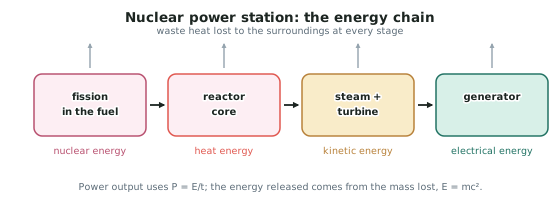
- Fission in the fuel → energy is released as the kinetic energy of the fast-moving fission fragments.
- Reactor core → those fragments collide with surrounding material, so the kinetic energy becomes heat.
- Steam and turbine → the heat boils water into high-pressure steam, whose kinetic energy spins a turbine.
- Generator → the spinning turbine drives a generator, producing electrical energy.
- Waste heat is lost to the surroundings at every stage, which is why no power station converts all the released nuclear energy into electricity.
Worked ExampleEnergy released and power output
In one hour of operation, a reactor's fuel loses a total mass of kg. Calculate the energy released, and the average power output of the reactor over that hour. ( m s−1)
Step 1 — Find the energy from the mass lost
Use , with the mass already in kilograms:
Step 2 — Convert the time to seconds
Power must be in joules per second, so the hour has to become seconds:
Step 3 — Find the power