Nuclear fusion
What fusion is
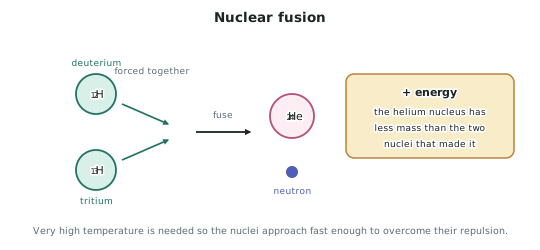
Nuclear fusion is the joining of two light nuclei to form a single heavier nucleus, releasing energy.
- Fusion is the process that powers the Sun and every other star.
- A typical fusion reaction joins the two heavy isotopes of hydrogen — deuterium () and tritium ():
- Check the conservation rules as always: mass numbers and ✓; atomic numbers and ✓.
Why fusion is hard to achieve
- Both nuclei are positively charged, so they repel each other electrically. The closer they get, the stronger the repulsion.
- To fuse, they must get close enough for the strong nuclear force to take over — and the strong force only acts over an extremely short range.
- Getting that close requires the nuclei to be moving extremely fast, which means an extremely high temperature (millions of degrees).
- Extremely high pressure or density is also needed, so that fast-moving nuclei actually meet each other often enough.
- In the Sun, gravity supplies the pressure and the core temperature is around 15 million K.
- On Earth, containing a gas that hot is the central engineering problem — no solid container can touch it.
Fission and fusion compared
| Fission | Fusion | |
|---|---|---|
| What happens | one heavy nucleus splits | two light nuclei join |
| Typical fuel | uranium-235, plutonium-239 | deuterium, tritium |
| Triggered by | absorbing a neutron | very high temperature and pressure |
| Waste | radioactive daughter nuclei, dangerous for a long time | helium, which is not radioactive |
| Used commercially? | yes — nuclear power stations | not yet — still experimental |
| Energy released per reaction | large | large (and larger per kilogram of fuel) |
- Both release energy because in both cases the products have less total mass than the reactants — the missing mass appears as energy (next page).
Why fusion would be worth the effort
-
The fuel is abundant. Deuterium can be extracted from ordinary seawater, and tritium can be bred from lithium. Uranium, by contrast, must be mined and is limited.
-
The waste is not the problem it is for fission. The main product is helium, which is not radioactive. Fission produces daughter nuclei that stay dangerously radioactive for thousands of years.
-
It cannot run away. A fusion reaction requires extreme conditions to be actively maintained; if containment fails the reaction simply stops. A fission chain reaction, by contrast, must be actively controlled to prevent it accelerating.
-
The energy per kilogram of fuel is larger than for fission.
-
The obstacle is entirely one of engineering, not physics: sustaining a plasma at over a hundred million kelvin, held away from any wall, for long enough to release more energy than was put in.
Worked ExampleCompleting and checking a fusion equation
Two deuterium nuclei fuse in the reaction . Identify particle X, and verify the reaction using the conservation rules.
Step 1 — Conserve mass number (the top numbers)
Step 2 — Conserve atomic number (the bottom numbers)
Step 3 — Identify the particle
A particle with and has one nucleon and no charge — it is a neutron, .
Step 4 — Check both rules on the completed equation
- Mass numbers: on the left; on the right ✓
- Atomic numbers: on the left; on the right ✓
Worked ExampleComparing the fuel needed
A fusion reaction releases about J per reaction, consuming nuclei of total mass about kg. A fission reaction releases about J per reaction, consuming a uranium-235 nucleus of mass about kg. Compare the energy released per kilogram of fuel in each case.
Step 1 — Energy per kilogram from fusion
Step 2 — Energy per kilogram from fission
Step 3 — Compare
Fusion releases roughly four to five times more energy per kilogram of fuel.