Nuclear fission and chain reactions
What fission is
Nuclear fission is the splitting of one large, unstable nucleus into two smaller nuclei, releasing energy and free neutrons.
- Fission is usually induced: a slow-moving neutron is absorbed by a heavy nucleus such as uranium-235, making it so unstable that it splits almost immediately.
- The two smaller nuclei produced are called daughter nuclei or fission fragments. They are not always the same two — uranium-235 can split in many different ways.
- Two or three fast neutrons are released each time.
- A large amount of energy is released, mostly as the kinetic energy of the fast-moving fragments.
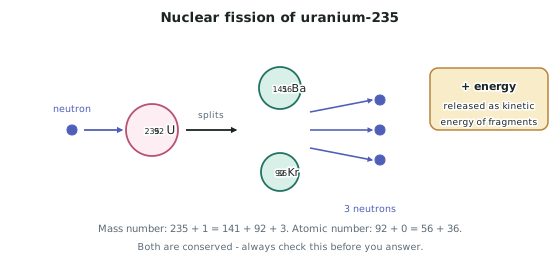
Writing a fission equation
A typical induced fission of uranium-235:
- Check the mass numbers (top): on the left; on the right. ✓
- Check the atomic numbers (bottom): on the left; on the right. ✓
- Exactly the same two conservation rules you used for alpha and beta decay apply here — mass number and atomic number are both conserved.
Chain reactions
Because each fission releases neutrons and is triggered by a neutron, one fission can cause several more.
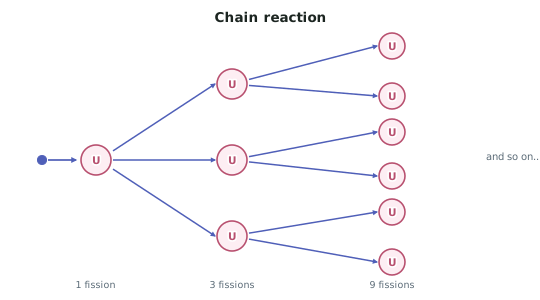
- A chain reaction is a self-sustaining sequence of fissions, where the neutrons from one fission go on to cause further fissions.
- If more than one neutron per fission goes on to cause another fission, the reaction grows — the number of fissions, and so the power output, increases rapidly. This is what happens in a nuclear weapon.
- If exactly one neutron per fission goes on to cause another, the reaction is steady and the power output is constant. This is what a nuclear reactor is designed to maintain.
- If fewer than one does, the reaction dies out.
Controlling a chain reaction in a reactor
- Control rods (boron or cadmium) absorb neutrons without undergoing fission. Pushing them further in absorbs more neutrons and slows the reaction; pulling them out speeds it up.
- A moderator (often water or graphite) slows the fast neutrons down, because slow neutrons are much more readily absorbed by uranium-235 — without it, most neutrons would escape without causing fission.
- Shielding (thick concrete and steel) absorbs the radiation released so it does not escape into the surroundings.
Worked ExampleCompleting and checking a fission equation
A uranium-235 nucleus absorbs a neutron and splits according to Find and , and state the two conservation rules you used.
Step 1 — Conserve mass number (the top numbers)
Left-hand side: .
Right-hand side: .
Step 2 — Conserve atomic number (the bottom numbers)
Left-hand side: .
Right-hand side: .
Step 3 — State the rules used
Mass number (total number of nucleons) is conserved, and atomic number (total charge) is conserved.
The krypton nuclide is .