Making the call and writing the inference
The idea of "making the call"
- You build an informal confidence interval for each group's population median.
- Then you ask one question: do the two intervals overlap?
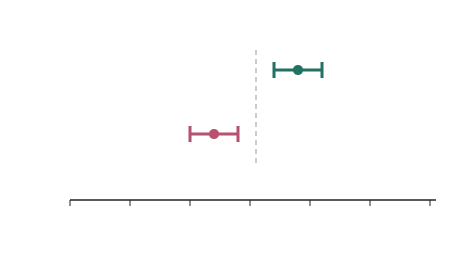
The overlap test
- No overlap → make the call: the group with the higher interval has the greater population median. The difference is big enough to survive sampling variability.
- Overlap → do not make the call: you cannot tell which population median is larger — the samples might be showing a difference that is just chance.
When you can make the call
- The intervals are clearly apart, with a gap between them.
- You may then say the higher group's population median is greater — a claim about all of that group, not just the sample.
Orchard A: , median 110 g, interval . Orchard B: a random sample of has median 96 g, , . Decide whether you can make the call.
Step 1 — Build Orchard B's interval
Step 2 — Compare the two intervals
- Orchard A: .
- Orchard B: .
- A's lower end (104) is above B's upper end (102), so the intervals do not overlap.
Step 3 — Make the call
When you cannot make the call
- If B's median had been 104 g, its interval would be , which overlaps A's between 104 and 110.
- Then the honest conclusion is: "Based on these samples, I cannot tell which population has the greater median weight."
- Overlap does not prove the medians are equal — only that this evidence is not strong enough to separate them.
Writing the inference (conclusion)
- A full conclusion has three parts:
- The call — which population median is greater, or that you cannot tell.
- The evidence — the two intervals and whether they overlapped.
- The context — the variable and the two populations, in words.
"The informal confidence intervals — Orchard A g and Orchard B g — do not overlap, so I estimate that the median weight of all Orchard A kiwifruit is greater than that of all Orchard B kiwifruit."
Sampling variability and honest claims
- Your call is about the populations, made from samples, so it is never certain — say "I estimate", not "I have proved".
- Avoid absolute words: not "every Orchard A kiwifruit is heavier", but "Orchard A's kiwifruit tend to be heavier".
- If you cannot make the call, suggest larger samples — bigger narrows both intervals and may let a real difference show.
Reaction times (ms): Year 11 sample , median 250, , . Year 13 sample , median 210, , . Make the call and write the conclusion.
Step 1 — Year 11 interval
Step 2 — Year 13 interval
Step 3 — Compare and call
Year 13 and Year 11 : the upper end of Year 13 (225) is below the lower end of Year 11 (232), so the intervals do not overlap.
Step 4 — Conclusion in context
Test yourself
Practice by grade
One question each at Achieved, Merit and Excellence. Have a go, then compare with the model answer.
Group A's interval is and Group B's interval is . Do the intervals overlap, and can you make the call?
Sample P (): median 60, , . Build P's interval and compare with Sample Q's interval . State your conclusion.
A study compares median incomes of two towns. The intervals overlap slightly, so no call can be made. Write a conclusion and explain what could be done to reach a call, referring to sampling variability.