The natural processes and their mechanisms
What has to be in a process sentence
- A process is a sequence of natural actions that shapes and changes an environment. Naming one is worth almost nothing on its own.
- Every process sentence needs four things: the process, the mechanism (what physically happens), the rate (how fast or how often), and the result (the feature or change it produces).
- Write them in that order every time. Lahars → a dense slurry of debris and water moves down the channel under gravity → about every 30 years → building the ring plain to 18 m of deposits.
- A sentence missing the mechanism is a label. Erosion has shaped the valley tells the marker only that you know the word.
- A sentence missing the rate cannot support an interaction argument later, because interaction at this level is usually about processes running at different speeds.
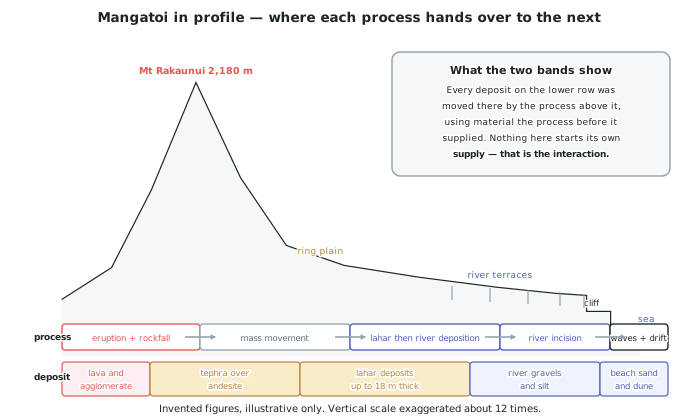
Volcanic and tectonic processes — the suppliers
- Volcanic and tectonic processes are driven by energy from inside the Earth. They add material and add height, which is what every other process then works on.
- Eruption on an andesitic cone like the invented Mt Rakaunui is explosive rather than effusive, because andesitic magma is viscous and traps gas. The 1655 eruption laid about 30 cm of tephra across the ring plain.
- Lahars are the process that connects the volcano to everything downstream: a slurry of volcanic debris and water, 60–70 per cent solids by weight, moving down an existing channel and stopping where the gradient flattens.
- Uplift on the invented Puketiro Fault raises greywacke at about 2 mm a year. Over the 25,000 years that matter to the present landscape that is 50 m of new height — small, continuous, and the reason erosion never finishes.
- Quote the rate, because the rate is the argument. Uplift at 2 mm a year against incision at 1.4 mm a year says the land is winning slowly; reverse those two numbers and the same environment would be flattening.
Climatic processes — the energy
- Climatic processes deliver water, wind and temperature change, and they are the fastest-acting family. Their effects appear within a student's lifetime.
- Orographic rainfall is the main one in Mangatoi: air forced up over a 2,180 m cone cools, condenses and drops 4,800 mm a year on the summit, falling to 2,100 mm on the ring plain and 1,150 mm at the coast.
- Say what the rain does, not just how much falls. On a 28° slope of bare tephra almost all of it runs off within minutes, because there is no soil or root network to hold it.
- Freeze-thaw operates above about 1,600 m, where the temperature crosses 0 °C repeatedly: water enters a joint, freezes, expands by about 9 per cent, widens the joint, and the cycle repeats until the block detaches.
- Wind matters at the coast, where onshore westerlies build the 12 m dune barrier from sand delivered by longshore drift.
Surface processes — the movers
- Mass movement delivers material downslope under gravity: debris flows on the upper cone, slumping in the mudstone near the coast. It needs a slope, loose material and usually water, so it sits exactly where the other three families overlap.
- Fluvial processes do three jobs and you should name which one you mean. Erosion cuts the channel; transport carries the load; deposition drops it when energy falls.
- The invented Mangatoi River has incised at about 1.4 mm a year averaged over 25,000 years, cutting five terraces, the highest 42 m above the modern bed.
- Coastal processes work at the receiving end. Wave erosion is retreating the 40 m mudstone cliff at Ōtaraki Head by about 0.4 m a year; longshore drift moves roughly 60,000 m3 of sand a year along the coast and built the barrier that ponds Te Waiora lagoon.
- Weathering is not erosion, and the distinction is examinable. Weathering breaks rock in place; erosion removes it. Freeze-thaw is weathering; the scree it feeds is moved by erosion.
Sorting the processes before you write
- Group your processes by what they do to material: some supply it (eruption, uplift, weathering), some move it (mass movement, rivers, waves, wind), some store it (deposition on the ring plain, in terraces, in dunes).
- That grouping is the fastest route to an interaction paragraph, because interaction is usually a supplier meeting a mover, or a mover meeting a store.
- Check every process you name is natural. Farming, forestry, engineering and tourism are cultural processes and belong in AS91427, not here — even when they are obvious in the environment.
- People can still appear in this answer as context, but the processes you analyse must be natural ones.
Worked Example
Worked example
Name ONE natural process operating in a New Zealand geographic environment you have studied. Explain how it operates and what it has produced.
Answer:
Step 1 — name the process and the family it belongs to, because the naming line comes first.
The process is fluvial incision — the downward erosion of a channel into the surface it crosses — and it belongs to the surface family. In the invented Mangatoi environment it has produced the five river terraces of the middle valley.
Step 2 — give the mechanism.
The Mangatoi River carries a heavy bedload of volcanic gravel delivered by lahars. That load is the tool: gravel dragged along the bed abrades it, deepening the channel. Where the flow strikes the bank, hydraulic action forces water into cracks in the lahar deposit and works blocks loose, which then join the load.
Step 3 — explain why incision produces a terrace rather than just a deeper channel.
A terrace forms when the river switches from building up to cutting down. While the load is large — in the decades after an eruption — the river cannot carry everything it is given, so it deposits and its bed rises across a wide floodplain. When the supply falls, the same discharge now has spare energy, and it cuts down into the surface it just built. The abandoned floodplain is left as a flat step above the new channel: a terrace.
Step 4 — quantify it.
Averaged over about 25,000 years the net incision has been roughly 1.4 mm a year, and the highest of the five terraces stands 42 m above the modern bed. The steps are not evenly spaced, which is the evidence that incision has not been steady.
Step 5 — state what the feature therefore records.
Each terrace marks one cycle of supply and removal. The terrace staircase is a record of how many times the balance between what the volcano supplied and what the river could carry has tipped.