Valuing skills and the extended concept answer
What valuing skills are
- Valuing skills are the fifth named skill in the standard, and the least practised: recognising what people value, why they value it, and how that explains what they want done.
- They are not about your own opinion. You read values out of the resources — a quotation, a submission, a photograph of a protest sign, a survey table.
- They are examined in the final part, where perspectives, sustainability and courses of action come up.
Perspective, viewpoint and value
- A value is something held to be important: profit, employment, tradition, clean water, access, guardianship of a place. A viewpoint is one person's opinion about a specific issue, and it can change on Tuesday.
- A perspective is a body of thought or worldview built up over time that shapes many people's values and explains why they consistently decide as they do.
- Perspective is the one that explains. The farmer opposes the reserve is a viewpoint. A productive-use perspective treats land as realising its value through being worked, so land locked up is value lost explains why that viewpoint is held, and predicts what else the group will oppose.
- Do not treat a perspective as a mistake. One you disagree with is still internally consistent, and answers that dismiss a side reason worse than answers that explain both.
Reading values out of a resource
- The noun a group uses for the same thing. Resource, asset, taonga, habitat and block all name the same hillside and each reveals a different value.
- What each group counts. A group quoting job numbers and one quoting water clarity are not disagreeing about the facts; they are measuring different things.
- The timescale, because groups arguing about a proposal usually differ over how far ahead to look, and that alone can produce opposite conclusions from the same evidence.
- Who bears the cost and who takes the benefit. Where those fall on different people, expect a disagreement, and say so.
- Māori concepts such as kaitiakitanga or mana whenua are evidence of a perspective — a stated relationship of guardianship or authority — so use the term if the booklet does.
The final part: what it looks like
- The last part is an extended answer about a geographic concept, and it is the only part that can reach Excellence.
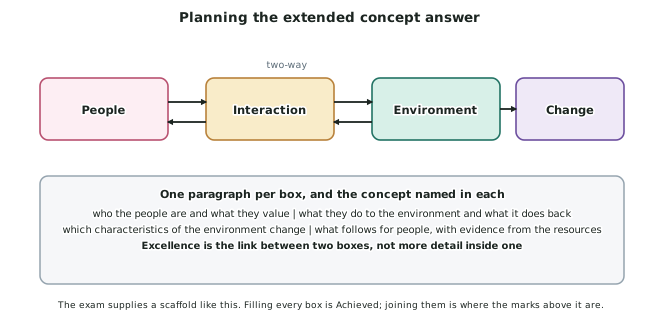
- The paper supplies a scaffold: labelled boxes such as People, Interaction, Environment, Change, or Change leading to economic, social and environmental sustainability.
- The scaffold is an instruction, not decoration. It tells you how many parts your answer needs and what each is about.
- Stem shapes to expect: how the interaction between people and the environment has affected people's perspective of it, or its sustainability; how social, environmental and economic sustainability have been affected by change; how location and accessibility have contributed to change over time.
Planning and structuring it
- Fill the scaffold in note form before writing, one line per box, with the specific evidence in it rather than just the topic — interaction: dairy conversion upstream, nitrate rise, swimming hole closed 2021 — so each paragraph is sourced before you start.
- Decide your linking sentence first. It joins two boxes, and it is the only part that can reach Excellence.
- Then write one paragraph per box, in the scaffold's order, naming the concept in the first sentence and using the word again rather than a synonym.
- Every paragraph carries evidence from the booklet. A box filled from general knowledge is the commonest reason a fluent answer stalls at Achieved.
- Finish with the linking paragraph and a conclusion that answers the question asked, not a summary.
What Excellence is, and what it is not
- Excellence here is thorough understanding of concepts, using geographic terminology, showing insight.
- Insight is defined in the standards as drawing a conclusion about how things link — between processes, elements of an environment, or groups of people.
- Excellence is not: more facts, a longer answer, more concepts named, or stronger opinions.
- Three routes that reliably produce a link: two concepts joined (the change here is a change in what the location is worth, not of industry); a two-way interaction traced (the environment shaped the settlement, which then changed how the environment behaves); two groups explained from one body of evidence (both perspectives fit the same figures, so more data will not settle it).
- Say where your claim stops. A sentence naming the limit of what the resources can support reads as control, not weakness.
Worked Example
Worked Example
The resource booklet describes the invented settlement of Kohu. The final part of the paper supplies a scaffold — People, Interaction, Environment, Change — and asks:
Explain how the interaction between people and the environment at Kohu has affected people's perspectives of it.
The resources supply: a population fall from 2,100 to 1,400; the freezing works closing with 240 jobs lost; a cycle trail opening in 2019; summer visitors rising from about 9,000 to about 31,000; a residents' group opposing a 60-bed lodge, and a business group supporting it.
Plan and write the linking section.
Answer:
Step 1 — fill the scaffold in note form, with evidence in each box.
- People — residents (1,400, down from 2,100); business owners (six cafés, two lodges since 2019).
- Environment — river mouth site, road access, flat terraces; the trail follows the river.
- Interaction — flat land and access made the site worth a works; when the works went, the same access made it worth routing a trail through; visitors then reshape the town.
- Change — population down about 33 per cent in two decades; visitors up more than threefold in seven years; activity shifted to the trail head.
Step 2 — decide the linking sentence before writing.
The link: the site never changed, but what it was worth changed twice — and the two groups formed their view of the town during different halves of that.
Step 3 — write the linking paragraph.
The interaction at Kohu has run in both directions, and that is what has produced two perspectives rather than one. The environment shaped the settlement first: the flat terraces at the river mouth were the only easily built-on land, and the road made them reachable, which is why the works were sited there. When the works closed nothing about the site altered, but with no employer to use it the same land was worth nothing, and the population fell by about a third. The trail then made those characteristics valuable again, to visitors rather than to stock. So the two groups are not disagreeing about the facts; they formed their sense of what Kohu is during opposite halves of that sequence. Residents watched one dominant activity empty the place and read the lodge as a repeat of that dependence; the business group watched an emptied town recover and reads it as more of what worked. Both readings fit every figure in the resources, which is why more figures have not settled the argument.
Step 4 — check it against the criteria. Four concepts named and applied to facts about Kohu; evidence in every claim; and a link with a conclusion drawn from it — the two perspectives come from the same evidence read across different periods, so more evidence cannot resolve them.
The link, in one line: