Close reading: passes, and the shape of a paragraph
Reading a text you have never seen
- Close reading means working out how a text achieves its effect from the text alone — no background, no prepared material, nothing but the words in front of you.
- The three text types are prose, poetry and non-fiction. Each rewards a different first look, but the method underneath is the same.
- Three things make an unfamiliar text tractable: a focus to read for, a method that splits the reading into passes, and a paragraph shape that turns an observation into analysis.
Finding the focus first
- Take the focus — the thing you are analysing towards — before you read the text. Reading cold means you notice whatever is loudest rather than what matters.
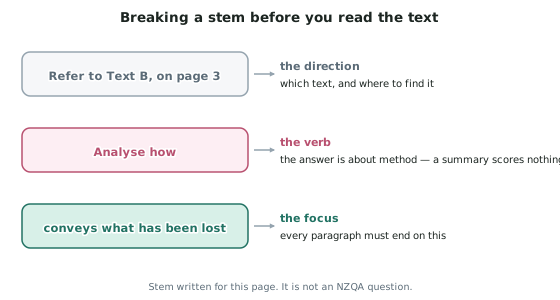
- The focus is a constraint, not a suggestion. Excellent analysis of something else is analysis of something else.
- Read the focus word by word. Lost, not changed, implies value — so the text must establish the thing mattered before it went.
Reading in passes
- Give each pass one job. Doing all four at once is why unfamiliar texts feel impossible.
- Pass one — no pen. Read for sense, then note your reaction in three or four words: uneasy, sad but not sentimental, being told off. Your reaction is evidence about the text's effect, and this is the only time you will read it without knowing what happens.
- Pass two — words. Connotations, unusual choices, small qualifiers.
- Pass three — syntax and structure. Sentence lengths, where they change, where paragraphs or stanzas break, first and last sentences.
- Pass four — voice and what is withheld. Who narrates, what they know, what tense, what they never say.
- Then decide your reading in one sentence before you write: this text does X by doing Y. Every paragraph then has something to be part of, and you can see which observations do not belong.
The paragraph shape
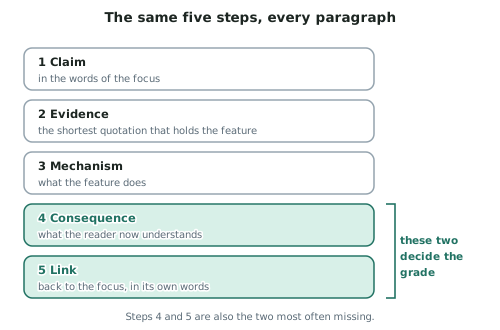
- Open with the claim, not the quotation. A paragraph beginning with copied text makes your reader wait to find out why they are reading it.
- Every paragraph must end on the focus. If it could be moved unchanged into an answer about a different focus, it is not yet answering this question.
- Some of the best evidence has no quotation marks available. It still counts if you point at it precisely — the father is given no dialogue; this is the last sentence of the poem.
- If a paragraph has to be shortened, cut examples, never the mechanism and the consequence — those two are the analysis, and everything else is illustration.
Worked Example
A question written for this page.
Step 1 — break the stem. Analyse how means the answer is about method, so a summary answers nothing. What has been lost: lost implies value, so the poem must establish the thing mattered before it went; has been means the loss is complete, so the poem speaks from after.
Step 2 — predict in one line. Probably: the poem establishes the value indirectly, then shows the world without it. Now your first read has a shape.
Step 3 — test the candidates with the removal test.
| Candidate aspect | If removed | Use it? |
|---|---|---|
| Planted over decades, felled in four days | The loss stops being disproportionate | Yes |
| Nothing you notice is doing its job | The poem never explains the family's inattention | Yes |
| The final couplet, brightness against wind | The poem has no ending and no loss | Yes |
| The word rows in line one | Almost nothing changes | No |
Step 4 — order them so the poem's own logic appears. Value established, then speed of removal, then consequence. Three paragraphs, thirteen minutes, one point each.