What close reading asks for
The question behind every question
- Whatever the wording, the question asks one thing: how does this text create its meaning and effect?
- Every answer has three parts, in this order.
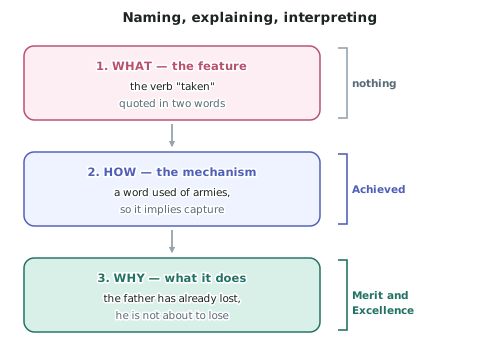
- Stopping after WHAT is the biggest single cause of lost marks. The writer uses a simile is worth nothing on its own.
- Stopping after HOW is the second. Saying what a simile makes you picture is not yet an interpretation — you have to say what that picture does to the meaning of the text.
Naming a feature is not analysing it
- This standard does not test whether you know technical terms. The terms are only labels.
- The short sentence stops the paragraph dead is worth more than the writer uses syntax.
- Use the correct term where you know it, but never let naming replace explaining.
- The crossing-out check. Delete every technical term from your paragraph. If what is left still says something about the text, it is analysis. If what is left is empty, it was a list of labels.
The four categories
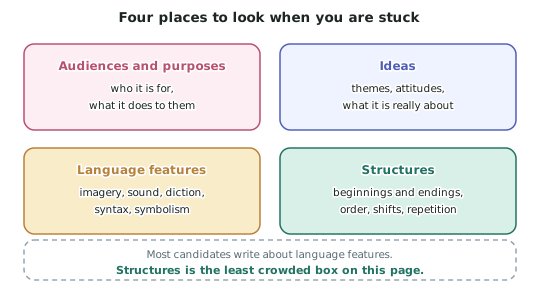
- The standard sorts everything you might discuss into four groups, so when you are stuck you have four places to look.
The grade ladder
- The same ladder runs through nearly every English standard. It is explained here once; later pages just name the grade.
| Grade | The standard's word | What it means |
|---|---|---|
| Achieved | developed | You identify a feature and explain a sensible effect |
| Merit | convincingly | Your interpretations are reasoned and clear |
| Excellence | perceptively | Your interpretations are insightful and/or original |
- Excellence is not length. Between the three grades the length barely changes; what increases is precision, then insight. The worked example shows one passage written at all three.
Worked Example
Worked Example
Read this passage, written for this page.
Analyse how the writer conveys the father's situation.
Answer — one passage at three grades.
Achieved. The verb taken in "The gorse had taken the hill" is a word used of armies, not plants. It implies capture, so the reader understands the father has already lost ground rather than being at risk of losing it.
Merit. The repetition of "through" builds a list whose items get steadily more solid — a fence line, then tyre ruts, then "split concrete", the most permanent thing on the farm. The gorse defeats progressively stronger barriers, and the sentence keeps accumulating instead of resolving, so its shape does the same work as its meaning. The two short sentences that follow, "The gorse came back. It always came back.", land abruptly after it, and the single added word always turns one event into a permanent pattern.
Excellence. The passage divides its verbs. The gorse gets verbs of conquest — had taken, came up, stood, came back. The father gets verbs of repetition without progress — he walked the boundary, stood, looked down. He is active every Sunday, and nothing he does is described as changing anything, so the grammar settles the defeat before any image does. The closing simile then changes the category of the problem: "a man waiting for the sea" replaces a weed, which is in principle defeatable, with something nobody has ever held back — and waiting, rather than fighting, removes even the pretence of resistance.