Choosing what to write about
Significant is not the same as noticeable
- The standard does not ask for aspects. It asks for significant aspects, and the word does real work.
- A significant aspect governs: remove it and the text means something different.
- An insignificant aspect decorates: remove it and the text reads flatter, but means the same.
- The most noticeable feature on a page is very often decorative, because writers make the decorative bits shiny and the structural bits invisible.
- This is the biggest cause of dull Achieved answers. They are correct, they quote accurately, and they analyse the wrong things.
The removal test
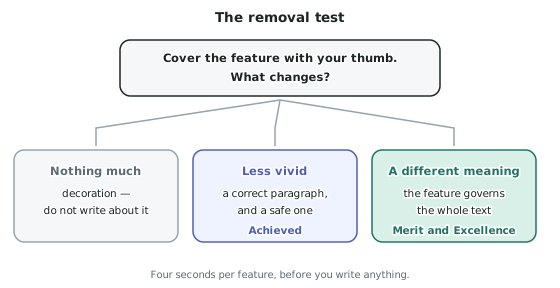
- The test takes four seconds and is the highest-value habit in this standard. Run it before you write, not after.
Which aspects usually govern
- Some features are structural by nature, so they are far more often significant. Look for these first.
- Who is speaking, and how much they know. First person blocks every mind but one. A change of narrator or of distance is almost always significant.
- Tense and time. Present tense leaves events unresolved; past tense reports them as finished. A shift between them is never accidental.
- Syntax. A long accumulating sentence and a two-word sentence do different work, and the difference is on every page.
- Patterns, and the break in a pattern. The break matters more than the pattern — the pattern sets the expectation, the break is what you were meant to feel.
- Beginnings and endings — the two most controlled positions in any text.
- What is withheld — information the writer could easily have given and did not.
Why hunting for imagery underperforms
- Imagery is local. One simile affects one sentence; syntax, tense and structure affect the whole text.
- Everybody finds it. A marker reads the same simile discussed the same way all day: correct, unremarkable, Achieved.
- It feels finished. Once you have said the simile makes the reader picture X, the paragraph sounds complete, so you stop before the interpretation the standard rewards.
- Figurative language is worth writing about when it governs — a man waiting for the sea changes the category of the problem. A simile comparing rain to needles usually does not.
Where insight is uncrowded
- Some observations are made by nearly every candidate and some by almost none. These are consistently uncrowded, and all of them are relations rather than items.
- The break in a pattern. Establish the pattern in one clause, then spend the paragraph on the exception.
- Two features that contradict each other — cheerful vocabulary in a sentence with a collapsing rhythm.
- A word doing two jobs, such as still meaning both motionless and yet.
- The same thing appearing twice and meaning differently. In a short text this is the most reliable route to Excellence.
- What the text declines to do — a character who never speaks, an emotion never named, a cause never given. To make an absence into evidence you must point at it precisely, or it sounds like an excuse for having nothing to quote.
How many aspects
- Two booklet pages is about three developed paragraphs, so you need two or three significant aspects, not eight small ones — ideally one language feature, one structural feature, and one touching purpose or the reader's position.
- Depth beats coverage every time. Three aspects taken to interpretation will outscore eight identified and abandoned.
Worked Example
Worked Example
Apply the removal test to four features of the gorse passage and decide which to write about.
| Feature | If it were removed | Verdict |
|---|---|---|
| "all that yellow" | The sentence is slightly less visual; the meaning is unchanged | Decorative |
| "with his mouth shut" | We no longer know the father never discusses it, so the child's judgement might be his | Significant |
| "a man waiting for the sea" | The whole judgement that the effort is futile disappears | Highly significant |
| the past perfect "had taken" | Was taking makes the outcome undecided, so it becomes a struggle, not an aftermath | Significant |
Choosing three from four. Write about the last three, ordered so the passage's own logic appears: the tense settles the outcome, the withheld conversation makes the child the only interpreter, and the simile delivers the judgement.