Prose, poetry and non-fiction
Prose: go to these three first
- The narrator. Who is telling this, and how do they know?
- First person gives access to one mind and blocks the others, so everything about other characters is filtered through someone with an interest. Third person varies in closeness.
- Phrases marking interpretation rather than fact — I thought, it seemed, as if — show the limits of what the text is claiming.
- Time, which can be compressed, stretched or jumped.
- Dialogue, or its absence. Who does not speak; what is said instead of the thing meant. He said and he said, too loudly are different sentences. Do not paraphrase dialogue — quote three words and explain what they cost.
In prose, track one thing until it moves
- Extracts chosen for this exam almost always contain a change, and finding the change is usually finding the answer.
- Follow one element as it moves rather than commenting on scattered features: physical distance between characters in the text's own units; who speaks first; a repeated object and what it means each time; the narrator's certainty, and whether the hedges disappear.
- A tracked element gives evidence with a direction. Three quotations forming a sequence say something no single quotation can.
- Read the first and last sentences together. If they differ, you have located the extract's movement in eight seconds.
Poetry: three reads, one job each
- A poem is short enough to hold in your head at once, so whole-text structure — hardest to reach in prose — is easiest here.
- First read — what is happening, literally? Do not analyse. Second read — what is the shape? Where it turns, where stanzas break, where sentences end relative to lines. Third read — the words.
- The line break is the one tool poetry has that prose does not. A sentence running over the break — enjambment — carries the reader forward and can suspend a meaning for a beat. A stanza break is a silence, and the last line is the most weighted position available.
- The turn — where the poem changes direction, mood or scale — is the highest-value thing to find, because everything before and after can be described in relation to it. It often sits at a stanza break, in the last few lines, or at a word like but, then, now, still.
- Ask what changes across it: tense, scale, addressee, tone. Then ask what survives it unchanged — a word that means something different afterwards is the most rewarding thing you can find in a poem.
- Sound generates more empty paragraphs than any other feature. The alliteration makes the line flow says nothing. Tie sound to sense: the hard consonants slow the line, so reading it takes as long as the action does. Leave the rhyme scheme alone unless it does something — a broken rhyme, or two rhymed words connected in a way that matters.
Non-fiction: purpose comes first
- In fiction and poetry, purpose is one aspect among several. In non-fiction it is the frame, because the text was written to do something to somebody. Begin there, before any language feature.
- What is this text trying to make the reader do, think or feel?
- Who is the reader, and what does the writer assume they already believe?
- Every feature you then analyse is explained as a means to that purpose. A metaphor in a persuasive column is not decoration; it is an argumentative move.
- Pronouns are the most reliable evidence of stance, and they are routinely missed. You puts the reader on the spot. We includes the writer in the group being described — ask who is inside it, and whether the reader agreed to be there. They creates an outside group, so a writer who moves from they to we has performed a manoeuvre.
- Evidence. Ask not is there evidence but what work it does: a precise number sounds authoritative, an anecdote is vivid and logically weak, a named authority borrows credibility. A writer who counts something specific converts an argument into an observation, which is harder to dispute.
- Non-fiction structure is the order of the argument, and it is as analysable as narrative sequence.
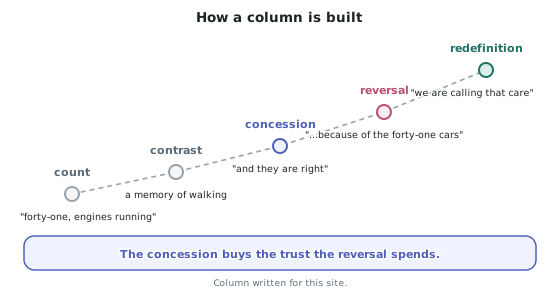
- The concession — stating the opposing view fairly, then answering it — is the strongest move in persuasive writing, because it buys the reader's trust. Look for and they are right, of course, admittedly.
- The redefinition — a word the reader approves of, such as safety, care or progress, shown being used for something else — is usually where a column lands its final blow.
- Where the concession sits matters: before the main argument it disarms, after it, it qualifies.
Worked Example
Worked Example
A. Prose. Read this extract, written for this page.
Analyse how the writer shows the developing friendship.
Track one thing. The gap is measured four times and the unit shrinks — "forty metres behind", "we walked together", "a half-step back", "a half-step ahead". The same kind of detail at four points makes the change measurable rather than asserted, and the narrator is still measuring at the end, which is what makes it a friendship forming rather than one already formed.
Then find what the extract will not say. Every emotional development is reported as a physical or accidental one. The turning point is disowned as it happens — "I stopped. I did not mean to stop; my feet did it." — an action reported, then reassigned to a body part.
B. Poetry. Read this poem, written for this page.
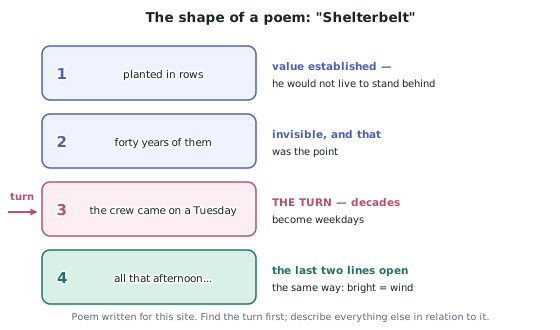
Where to start. The shape gives you the turn — the crew arrive at stanza three and the poem moves from decades to weekdays, "Forty years" against "on a Tuesday" and "By Friday". The last two lines begin identically, which forces a comparison, and brightness turns out to be the same event as audible wind. A full answer is worked through in the graded questions below.
C. Non-fiction. Read this column, written for this page.
Analyse how the writer challenges the reader's thinking about safety.
Read the order before the imagery. The central move is a reversal, prepared before it is sprung. The parents' position is given in their own words — "it isn't safe" — and then conceded: "And they are right." A reader braced for criticism since the headline is disarmed by agreement. Only then does the sentence complete itself: "It isn't safe — because of the forty-one cars."