Public goods and imperfect information
Public goods
- A public good has two defining characteristics, and both must be present.
- Non-excludable — once it is provided, you cannot stop people who have not paid from using it.
- Non-rival — one person's use does not reduce what is available to anyone else.
New Zealand examples: national defence, street lighting, flood protection stopbanks, lighthouses, the legal system, public broadcasting of civil defence warnings.
Why the market provides none of it
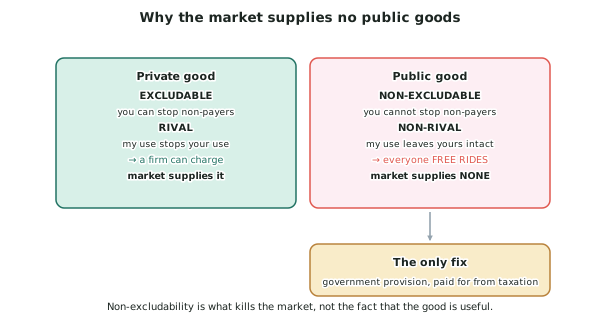
- Non-excludability is what kills the market, not the fact that the good is useful.
- Because non-payers cannot be excluded, every individual reasons: "the good will be provided whether or not I pay, so I will not pay." This is the free rider problem.
- If everybody free rides, nobody pays, so no firm can earn revenue and no firm will supply it. The market provides zero, and the socially optimal quantity is clearly greater than zero.
- Non-rivalry compounds it: because one more user costs nothing to serve, the marginal cost of an extra user is zero, so charging any positive price would exclude people who could have been served for free — which is itself inefficient.
The intervention: because free riding cannot be solved by any private arrangement, the standard names only one intervention for public goods — government provision, funded from taxation, which removes the choice of whether to pay.
Quasi-public goods
- Many real goods are partly excludable or partly rival, and it is worth saying so.
- A road is non-rival at 3am and highly rival at 8am when it is congested. It is non-excludable in most places but excludable where tolls exist.
- A national walking track is non-rival when quiet and rival when crowded, and it is expensive but not impossible to exclude non-payers.
- The clarification names national walking tracks and public infrastructure as legitimate contexts, so quasi-public goods are firmly in scope.
Imperfect information
- Imperfect information occurs when buyers or sellers do not have the information they need to make a good decision.
- The market fails because prices only allocate efficiently when the people responding to them know what they are buying.
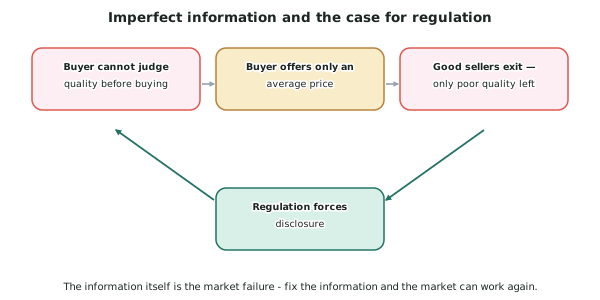
How it makes a market fail
- Suppose buyers cannot tell a high-quality item from a low-quality one before purchase.
- Unable to judge, they will only offer an average price.
- That average price is below what a high-quality item is worth to produce, so high-quality sellers leave the market.
- The average quality remaining then falls, so buyers lower their offer further, and more good sellers exit.
- The market ends up dominated by low-quality goods, and buyers who would happily have paid for quality cannot obtain it. Transactions that would have benefited both parties do not happen.
Types
- Asymmetric information — one side knows more than the other. A used-car seller knows the car's history; the buyer does not.
- Missing information — neither side knows. Long-term health effects of a new product.
The intervention: the standard names regulation for imperfect information — requirements to disclose, to label, to hold a licence, or to meet a minimum standard.
New Zealand examples: the Fair Trading Act 1986, which prohibits misleading conduct; mandatory nutrition information panels; building consents and Licensed Building Practitioner requirements; the Consumer Guarantees Act 1993; vehicle Warrant of Fitness requirements; the Financial Markets Conduct Act 2013 requiring disclosure by financial product issuers.
Why regulation is the right tool here
- The failure is the information itself, not the price. Once buyers can judge what they are buying, the market can work normally.
- This is unusual: most interventions in this standard change the quantity. Regulation to fix information restores the market's ability to find the right quantity by itself.
Worked ExampleAssessing whether a good is a public good
A regional council is considering four projects. For each, decide whether it is a public good, a quasi-public good or a private good, and say whether a market would supply it.
- A network of flood protection stopbanks along a river.
- A public swimming pool with an entry desk.
- Street lighting in a residential suburb.
- A regional walking track with an unstaffed carpark at the trailhead.
Step 1 — Set up the two tests
For each, ask:
- Excludable? Can non-payers be stopped from using it?
- Rival? Does one person's use reduce what is available to others?
A public good is non-excludable AND non-rival.
Step 2 — Flood protection stopbanks
Excludable? No. Once the stopbank protects the flood plain, it protects every property behind it. There is no way to flood one house and not its neighbour on the basis of who contributed.
Rival? No. The protection given to one property does not reduce the protection available to any other.
Verdict: a pure public good.
Would a market supply it? No. Every property owner reasons that the stopbank will either be built or not, and their own contribution is too small to determine which, so the rational choice is to free ride. Because all reason identically, nobody contributes, no revenue is raised, and no firm builds it. The market supplies zero even though the protection is worth far more than it costs.
Intervention: government provision, funded from rates or taxation.
Step 3 — A public swimming pool
Excludable? Yes. The entry desk is precisely a mechanism for excluding non-payers.
Rival? Yes, at least partly. A crowded pool is unpleasant, so one person's use does reduce what is available to others once capacity is approached.
Verdict: a private good — although one with a positive consumption externality, because a community that swims is healthier and children who learn to swim are less likely to drown.
Would a market supply it? Yes. Private pools and gyms exist and charge admission.
Why a council might still provide it: not because of the free rider problem, but because of the positive consumption externality and because of equity — access for households who could not afford a commercial gym. That is a merit good argument, not a public good one, and it should be argued as such.
Step 4 — Street lighting
Excludable? No. Light falls on everyone who walks down the street. There is no practical way to darken the footpath for someone who did not pay.
Rival? No. One person walking under the light does not reduce the light available to anyone else.
Verdict: a pure public good.
Would a market supply it? No — the same free rider reasoning applies.
Intervention: government provision.
Step 5 — A regional walking track with an unstaffed carpark
Excludable? In principle yes, in practice barely. A staffed gate could exclude non-payers, but the cost of staffing a remote trailhead is likely to exceed anything collected, and walkers can often access the track from other points.
Rival? Not at low use, but yes at high use. An empty track is non-rival; a crowded one is congested, and the experience degrades.
Verdict: a quasi-public good. It has the characteristics of a public good at low use and drifts towards a private good as use rises. The NZQA clarification explicitly names national walking tracks as a legitimate context for this standard.
Would a market supply it? Unlikely. The cost of exclusion is close to the revenue available, so no commercial operator would build and maintain it.
Intervention: government provision, with the possibility of a voluntary contribution or a user charge at a staffed point where the track's popularity makes exclusion worth its cost. The council should also note that as use rises, the good becomes more rival, which strengthens the case for a charge that manages congestion.
Step 6 — The general lesson
| Project | Excludable | Rival | Type | Market supplies? |
|---|---|---|---|---|
| Stopbanks | No | No | Public good | No |
| Swimming pool | Yes | Yes | Private (merit) | Yes |
| Street lighting | No | No | Public good | No |
| Walking track | Barely | At high use | Quasi-public | Unlikely |
Non-excludability is the test that matters. Every good the market refuses to supply here fails on that characteristic, and the good the market will supply — the pool — is the one with a gate on the door.