Choosing between two interventions
What Excellence actually requires
The standard is precise, and this page is built around its exact words:
Comprehensive understanding involves using a detailed explanation to make a justified recommendation on which government intervention is better in terms of efficiency and equity, and integrating an economic model into the justified recommendation.
Three things must be present:
- Two interventions addressing one market failure.
- A recommendation — you must actually pick one.
- A justification on BOTH efficiency and equity, with the model integrated into the argument.
The interventions available
From the standard's own list, by failure type:
| Failure | Interventions named |
|---|---|
| Consumption externality | Subsidies, taxes, regulations, property rights, government provision |
| Production externality | Subsidies, taxes, regulations, property rights, government provision |
| Public goods | Government provision |
| Imperfect information | Regulation |
| Inequitable income/wealth | Progressive taxes, welfare benefits, collective provision, minimum wage |
| Under-provision of a merit good | Collective provision, government grants, targeted services |
- The list is "may include, but are not limited to", so a well-justified alternative is acceptable — but the named ones are the safe choices.
How each intervention works on the model
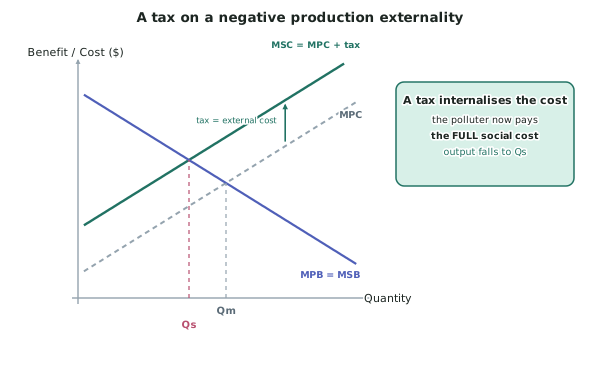
A tax on a negative externality
- Shifts the private cost curve up onto SMC, so the producer or consumer now faces the full social cost.
- Moves Qm left towards Qs. The externality is internalised.
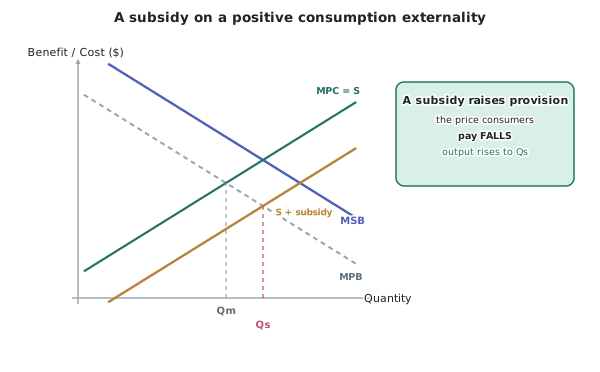
A subsidy on a positive externality
- Shifts the supply curve down and right, lowering the price consumers pay.
- Moves Qm right towards Qs.
Regulation — a legal limit, standard or ban
- Fixes the quantity or the method directly, rather than changing the price signal.
- Can hit Qs exactly, but only if the regulator knows where Qs is.
Property rights — assigning ownership of the affected resource
- Gives the third party something to defend or to trade, so the externality can be negotiated privately.
- Works when the parties are few and easily identified; fails when they are many.
Government provision — the state supplies it directly
- The only option for a public good, and used for merit goods where access matters.
The assessment framework
Run every intervention through both tests, and use these questions.
Efficiency
- Does it move Qm towards Qs? By how much?
- Does the welfare loss triangle shrink? Does any of it remain?
- Does it create a new distortion — a work disincentive, an administrative cost, a black market?
- Can the government measure what it needs to know to set it correctly?
Equity
- Who pays for it, and who benefits?
- Is the burden progressive or regressive relative to income?
- Does it improve access for those with the least ability to pay?
- On a Lorenz curve, does it pull the curve towards the 45-degree line?
Writing the recommendation
The structure that works:
- Name the failure and diagnose it on the model. Qm, Qs, which is bigger, where the welfare loss sits.
- Intervention one — efficiency, then equity. Use the model.
- Intervention two — efficiency, then equity. Use the model.
- Compare them directly on each test, and say where they disagree.
- Recommend one, and say on what grounds — which test you weighted more heavily and why.
- State the condition under which your recommendation would change.
- Step 6 is what separates a strong Excellence answer from an adequate one. A recommendation that could not be wrong under any circumstances has not been justified.
Worked ExampleA full two-intervention comparison
An illustrative dairy region has a negative production externality: farm runoff degrades a river used for swimming, fishing and drinking water supply.
The council is considering:
- Intervention A — a tax on nitrogen fertiliser, set at the estimated external cost per unit.
- Intervention B — a regulation capping the nitrogen that may be applied per hectare.
Assess both on efficiency and equity, and make a justified recommendation.
Step 1 — Diagnose the failure on the model
This is a negative production externality: the harm arises from the act of producing, and it falls on third parties — swimmers, recreational and commercial fishers, and the district paying to treat drinking water.
On the SMB/SMC model:
- MPB = MSB, because nobody outside the market is affected by the consumption of dairy products.
- SMC = MPC + external cost, so SMC lies above MPC.
- The market settles at Qm where MPB = MPC; the social optimum is Qs where SMB = SMC.
- Qm > Qs — nitrogen is over-applied and dairy output is over-produced.
- The welfare loss is the triangle between SMC above and SMB below, across Qs to Qm.
Step 2 — Intervention A, the tax: efficiency
A tax set equal to the external cost per unit shifts the private cost curve up onto SMC, so the farmer faces the full social cost. On the model Qm moves left to Qs and the welfare loss triangle is eliminated — the externality is internalised.
Two further gains, both of which come from the tax applying to every unit:
- Abatement happens where it is cheapest. Each farmer cuts nitrogen until their own cost of cutting one more unit equals the tax, so the region's total reduction is achieved at the lowest possible cost.
- The incentive to innovate never switches off. A farmer who finds a lower-nitrogen method keeps saving money indefinitely.
Weakness: the rate must equal the external cost, which the council can only estimate. Too low and Qm never reaches Qs; too high and it overshoots past Qs, creating a new welfare loss on the other side.
Step 3 — Intervention A, the tax: equity
- Who pays: farmers, with part passed to consumers through higher dairy prices — how much depends on relative elasticity.
- Regressive element: dairy is a necessity with inelastic demand, so much of the tax reaches consumers, and low-income households spend a larger share of income on food.
- Progressive elements: the heaviest nitrogen users — generally the largest farms — pay the most, and the beneficiaries are swimmers, fishers and water users who could never buy river access privately.
- Net assessment: mixed — progressive in who pays among producers and who benefits, regressive in its pass-through to food prices.
Step 4 — Intervention B, the regulation: efficiency
A per-hectare cap can be set so total application falls to the level consistent with Qs, hitting it exactly if the council knows where Qs is.
The weaknesses are substantial:
- Abatement is not equalised. Every farm meets the same cap however cheaply or expensively it can comply, so the same total reduction costs the region more than under the tax.
- The incentive stops at the cap. There is no reward for going below it.
- Monitoring and enforcement carry administrative cost and non-compliance risk.
- It ignores farm differences — soil, rainfall, slope and distance to water all change how much harm a given application does.
Its advantage is certainty of quantity. A tax influences behaviour without guaranteeing the outcome; if demand for nitrogen is more inelastic than estimated, application falls less than intended. Where damage becomes irreversible past a threshold, that certainty is genuinely valuable.
Step 5 — Intervention B, the regulation: equity
- Who pays: farmers bear compliance costs, and less reaches consumers than under the tax, because nothing is charged for the nitrogen still applied.
- Among farmers it is regressive — the reverse of the tax. The cap bites hardest on those least able to adapt, typically smaller operations without the capital for precision application.
- No revenue exists to redistribute. The tax could fund river restoration or offset food prices for low-income households; the regulation raises nothing, so its costs cannot be compensated.
Step 6 — Compare them directly
| Tax | Regulation | |
|---|---|---|
| Moves Qm to Qs | Yes, if set correctly | Yes, if set correctly |
| Cost of achieving it | Lowest — abatement equalised | Higher — uniform requirement |
| Ongoing innovation incentive | Yes, on every unit | No, stops at the cap |
| Certainty of quantity | No | Yes |
| Sensitive to farm differences | Yes, automatically | No |
| Revenue raised | Yes | None |
| Burden among farmers | Falls on highest users | Falls on least adaptable |
| Pass-through to food prices | Larger — regressive | Smaller |
| Compensation possible | Yes, from revenue | No |
Where they disagree: the tax is better on cost-effectiveness, innovation, flexibility and the ability to compensate; the regulation is better on certainty and has a smaller regressive pass-through.
Step 7 — The justified recommendation
Recommend the tax, on the following grounds.
On efficiency it is clearly superior. Both can reach Qs, but the tax reaches it at lower total cost to the region, because it equalises the marginal cost of abatement across farms rather than imposing a uniform requirement on farms with very different circumstances. It also maintains an ongoing incentive to find lower-nitrogen methods, which the regulation destroys the moment the cap is met. Over time that dynamic effect is likely to exceed the static one.
On equity it is defensible, and its weakness is fixable. Its regressive pass-through to food prices is a genuine cost — but the tax raises revenue, and that revenue can be used to offset it, through river restoration in the affected community and through targeted support for low-income households. The regulation raises nothing, so its equity costs cannot be compensated at all. An intervention whose costs can be offset is preferable to one whose costs, though smaller, are permanent.
The tax also falls on the highest nitrogen users rather than on the least adaptable farms, which is the more defensible distribution among producers.
The condition that would reverse this recommendation. If the council's scientific advice identifies a threshold of nitrogen loading beyond which damage to the river is irreversible, then certainty of quantity becomes the overriding consideration and the regulation is correct. A tax influences behaviour but cannot guarantee the loading stays below a hard limit, because the response depends on how elastic farmers' demand for nitrogen turns out to be. Where the cost of overshooting is irreversible, the tax's flexibility becomes its fatal weakness.
The recommendation in that case would be a regulated cap set at the threshold, with a tax applied to nitrogen used below the cap — combining the certainty of the regulation with the cost-effectiveness and revenue of the tax.