Regulation, deregulation and trade policy
Regulation and deregulation
- Regulation means the government setting rules about how a market operates.
- Deregulation means removing those rules.
- Who: MBIE, the Commerce Commission, sector regulators, and councils under the planning system.
What regulation can do
| Type | Example | Effect |
|---|---|---|
| Price controls | A maximum or minimum price | Changes the price directly, creating shortage or surplus |
| Quantity limits | A fishing quota, a resource consent | Limits how much of a scarce resource is used |
| Standards | Safety, building, environmental, labelling | Raises firms' costs; AS shifts left in the short run |
| Entry rules | Licensing, consenting, planning rules | Restricts supply into a market |
| Competition rules | Commerce Commission action against anti-competitive conduct | Lowers prices and raises output |
Why governments regulate
- To correct a market failure — pollution, monopoly power, unsafe products, information the buyer cannot check.
- To manage the allocation of scarce resources — water, fisheries, land, road space. This is the standard's own phrase, so regulation is the natural policy family for a resource-allocation issue.
- To protect people who cannot protect themselves in a transaction.
Why governments deregulate
- Rules impose compliance costs, which raise firms' costs of production and shift AS left.
- Entry restrictions reduce supply and competition, raising prices.
- Removing unnecessary rules shifts AS right and can shift the PPF outward by letting resources move to higher-value uses.
The trade-off, in one line: regulation buys protection at the cost of higher costs and less output; deregulation buys lower costs and more output at the cost of less protection.
Free trade and protection policy
- Who: MFAT, negotiating on the government's behalf.
Free trade policy
- Free trade agreements — CPTPP, NZ–UK, NZ–EU — reduce or remove tariffs, quotas and discriminatory rules.
- Effect: New Zealand exports reach the partner market without a tariff wedge, so demand for New Zealand product rises. On the two-country model the trade price Pt rises and New Zealand exports increase.
- Flow-ons: higher export receipts () → AD right → growth and employment up; higher demand for NZ$ → appreciation; cheaper imports → AS right and lower prices.
Protection policy
- Tariffs — a tax on imports, raising the domestic price.
- Quotas — a limit on the quantity imported.
- Subsidies — payments to domestic producers, lowering their costs.
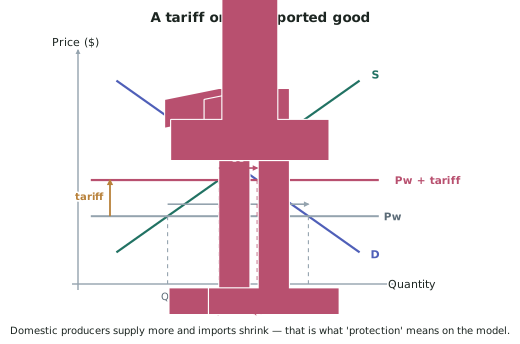
- Effect of a tariff: domestic supply rises from Qs to Qs1, domestic demand falls from Qd to Qd1, imports shrink from M to M1, and the government collects tariff revenue.
- Winners: domestic producers, the government. Losers: domestic consumers, and any firm using the good as an input.
Why New Zealand generally chooses free trade
- New Zealand is small and export-dependent, so it needs other countries' markets open.
- Protection raises prices for New Zealand consumers and misallocates resources into industries where New Zealand's opportunity cost is high.
- Retaliation would cost New Zealand exporters far more than protection could gain.
Worked ExampleRegulation as the target policy
A New Zealand region has a shortage of affordable housing. Land near the city is restricted by planning rules that limit how densely it can be built.
The government's objective is to increase housing supply.
Explain the direct impact of deregulating the planning rules, and the flow-on effects on economic growth and on inflation.
Step 1 — Name the objective and the policy family
Objective: increase the supply of housing so that scarce land and construction resources are allocated to housing.
Policy: deregulation — relaxing planning rules to allow greater density and faster consenting.
Family: regulation/deregulation. Note that this is a supply-side policy in a single market.
Step 2 — The direct impact on the housing market
Planning rules currently restrict how much housing can be built on the available land, so supply is limited by regulation rather than by resources.
Relaxing them means developers can build more dwellings on the same land, so they are willing to supply more at every price.
On the market model, supply shifts right, from S to S1. Demand is unchanged.
At the new equilibrium: the price falls from Pe to Pe1 and the quantity of housing rises from Qe to Qe1.
The objective is achieved: more housing, at a lower price.
Step 3 — Flow-on to economic growth. Positive.
More construction activity. Building more dwellings raises output directly, and construction is labour-intensive, so — through derived demand — employment rises.
AD shifts right, because residential construction is investment ().
AS shifts right too, over time. Housing near employment centres lets workers live closer to jobs, which raises labour mobility and reduces time lost commuting. Lower housing costs also mean firms can attract staff without paying as much, lowering their costs.
On the PPF, the frontier shifts outward: the region can produce more with the same land, because the land is being used more intensively.
Step 4 — Flow-on to inflation. Mixed, and this is the interesting part.
Downward pressure through housing costs. Housing and household utilities carry a large weight in the CPI. Lower rents and housing costs therefore reduce measured inflation by more than an equivalent price fall in a smaller category. Lower housing costs also reduce wage pressure, because workers need less income to cover rent — which restrains cost-push inflation.
Upward pressure through construction demand. In the short run, a building boom competes for scarce construction labour and materials. Wages and material prices in construction rise, which raises building costs. That is AS shifting left in that sector.
Net effect: upward pressure in the short run while building capacity is stretched, and downward pressure in the long run as the additional dwellings reduce housing costs across a heavily-weighted CPI category.
Step 5 — Note what is given up
Deregulation is not costless, and saying so strengthens the answer.
Planning rules exist for reasons — infrastructure capacity, amenity, environmental protection, natural hazard management. Relaxing them may mean infrastructure that cannot cope, loss of green space, or building in unsuitable locations. Those costs are real, are borne by existing residents, and are exactly the kind of thing net social welfare counts and real GDP does not.