Policy objectives and the four policy families
What a policy objective is
- A policy objective is the specific outcome the government is trying to achieve.
- The standard requires you to identify policies "that achieve specific policy objectives relating to one contemporary economic issue" — so the objective must be named and specific, not "make the economy better".
| Issue | A specific policy objective |
|---|---|
| Inflation | Keep annual CPI inflation within the RBNZ's 1–3% target band |
| Unemployment | Reduce the unemployment rate, particularly cyclical unemployment |
| Economic growth | Raise real GDP growth, or raise productive capacity |
| International trade | Improve the balance on goods and services, or secure market access |
| Housing / resource allocation | Increase housing supply; allocate water or road space efficiently |
The four policy families
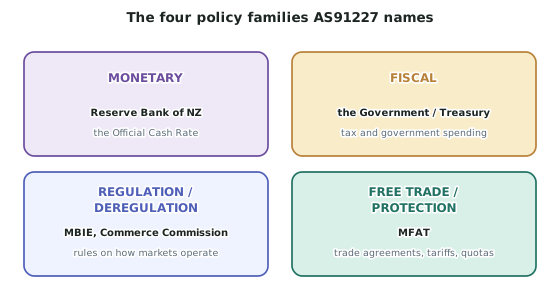
Monetary policy
- Who: the Reserve Bank of New Zealand (RBNZ), through its Monetary Policy Committee, under the Reserve Bank of New Zealand Act 2021.
- Tool: the Official Cash Rate (OCR).
- Objective set by the Remit: annual CPI inflation of 1–3%, focused on the 2% midpoint.
- Independent of the government of the day — the RBNZ, not the Minister, sets the OCR.
Fiscal policy
- Who: the Government, advised by the Treasury, through the annual Budget.
- Tools: government spending () and taxation.
- Affects AD directly, and can affect productive capacity where the spending is on infrastructure, health or education.
Regulation and deregulation
- Who: MBIE, the Commerce Commission, and sector regulators; councils under the planning system.
- Tools: rules on prices, entry, standards, safety, resource use and land use.
- Regulation adds rules; deregulation removes them.
Free trade and protection
- Who: MFAT, negotiating on the government's behalf.
- Tools: free trade agreements (CPTPP, NZ–UK, NZ–EU) on the free trade side; tariffs, quotas and subsidies on the protection side.
Expansionary and contractionary
- Every macroeconomic policy is one or the other, and naming which is a quick Achieved mark.
| Monetary | Fiscal | Effect on AD | |
|---|---|---|---|
| Expansionary | Cut the OCR | Raise spending or cut taxes | AD shifts right — growth and employment up, price level up |
| Contractionary | Raise the OCR | Cut spending or raise taxes | AD shifts left — price level down, growth and employment down |
Demand-side and supply-side
- Demand-side policies work by shifting AD. Monetary and fiscal policy are principally demand-side.
- Supply-side policies work by shifting AS or by shifting the PPF outward — raising productive capacity.
- Education and training, infrastructure, R&D support, deregulation that lowers business costs, trade agreements that give firms cheaper inputs.
- Which side a problem is on determines which policy can fix it. Cyclical unemployment is a demand-side problem; structural unemployment is a supply-side one.
Worked ExampleMatching objective, policy and family
For each situation, state the policy objective, name a suitable policy, and say which of the four families it belongs to.
(a) Annual CPI inflation has risen to 6.2%. (b) Cyclical unemployment has risen sharply during a recession. (c) Exporters cannot access a large overseas market because of high tariffs. (d) Housing is unaffordable because supply is not keeping up with demand.
Step 1 — (a) Inflation at 6.2%
Objective: return annual CPI inflation to the RBNZ's 1–3% target band.
Policy: contractionary monetary policy — the RBNZ's Monetary Policy Committee raises the OCR.
Family: monetary policy.
Why it fits: the objective is explicitly the RBNZ's under its Remit, and the OCR is the instrument designed for it.
Step 2 — (b) Cyclical unemployment in a recession
Objective: reduce cyclical unemployment by raising aggregate demand.
Policy: expansionary fiscal policy — increase government spending () on infrastructure, or cut income tax to raise consumption (). Expansionary monetary policy — cutting the OCR — would also work.
Family: fiscal policy (or monetary).
Why it fits: cyclical unemployment is caused by deficient demand, so a demand-side policy that shifts AD right addresses the actual cause. Supply-side retraining would not, because the skills are not the problem.
Step 3 — (c) Tariffs blocking exporters
Objective: improve market access for New Zealand exports and the balance on goods and services.
Policy: negotiate a free trade agreement through MFAT to reduce or remove the tariffs.
Family: free trade and protection.
Why it fits: the barrier is a foreign government's tariff, which is a trade-policy instrument. No amount of domestic monetary or fiscal policy removes a tariff.
Step 4 — (d) Housing supply
Objective: increase the supply of housing so that scarce land and construction resources are allocated to it.
Policy: deregulation of land use and consenting rules to allow more building; or fiscal spending on infrastructure that opens land for development.
Family: regulation/deregulation (or fiscal).
Why it fits: this is a supply-side problem in one market. Raising AD through lower interest rates would raise housing demand against a fixed supply, pushing prices up — the opposite of the objective.