Monetary policy and the Reserve Bank
What monetary policy is
- Monetary policy is action taken by the Reserve Bank of New Zealand (RBNZ) to influence interest rates and therefore spending in the economy.
- Decisions are made by the Monetary Policy Committee under the Reserve Bank of New Zealand Act 2021, and published in the Monetary Policy Statement.
- The RBNZ operates independently of the government of the day.
The objective — the Remit
- The RBNZ's Remit requires it to keep annual CPI inflation between 1% and 3%, with a focus on the 2% midpoint.
- That is the specific policy objective to name in your report when the target issue is inflation.
The instrument — the Official Cash Rate
- The OCR is the interest rate the RBNZ sets for its dealings with registered banks.
- Changing it changes banks' cost of funds, which they pass into mortgage, business lending and deposit rates.
The transmission mechanism — the chain you must be able to write
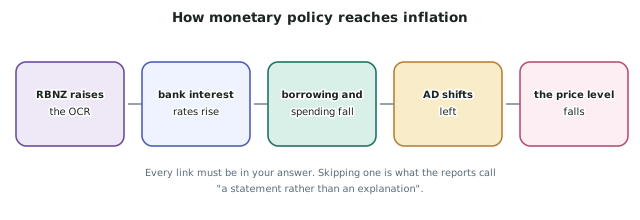
Contractionary — raising the OCR to reduce inflation:
- The RBNZ raises the OCR.
- Retail banks raise mortgage, business lending and deposit rates.
- Borrowing is dearer and saving more rewarding, so households spend less ( falls) and firms find fewer projects worth financing ( falls).
- Since , aggregate demand shifts left, from AD to AD1.
- At the new intersection with AS, the price level falls from PL to PL1 and real GDP falls from Y to Y1.
Expansionary — cutting the OCR — reverses every step.
The second channel: the exchange rate
- Higher New Zealand interest rates make New Zealand deposits and bonds more attractive to overseas investors.
- To invest here they must buy NZ$, so demand for NZ$ shifts right and the NZ$ appreciates.
- An appreciation makes imported goods and inputs cheaper in New Zealand dollars, which:
- lowers the CPI directly, and
- lowers firms' costs, shifting AS right.
- This channel reinforces the disinflation — and it is a strong detail to include, because most students only write the first chain.
Long and variable lags
- Monetary policy affects inflation with a lag of roughly a year to eighteen months.
- Why: households on fixed-rate mortgages only feel a change when they refix; firms' investment decisions were made months earlier; and prices in the CPI basket are reset at intervals, not continuously.
- Consequence for your report: an OCR change made today is aimed at inflation next year, so the RBNZ must act on forecasts, not on the current number.
Strengths and weaknesses
| Strengths | Weaknesses |
|---|---|
| Fast to deploy — a committee decision, not legislation | Long, variable lags before it works |
| Easily reversed | Blunt — hits every borrower equally |
| Independent, so it is credible and not driven by the electoral cycle | Cannot target a region or a group |
| Works through two channels (spending and the exchange rate) | Cannot fix supply-side problems |
Worked ExampleThe direct impact, fully explained
Annual CPI inflation is 5.8%. The RBNZ raises the OCR by 0.75 percentage points.
Explain the direct impact of this policy on inflation. Refer to an economic model in your answer.
Step 1 — State the objective
The RBNZ's Remit requires annual CPI inflation to be within 1–3%. At 5.8% it is well above the band, so the objective is to return inflation to the target band.
Step 2 — Link the OCR to retail interest rates
The OCR is the rate at which the RBNZ deals with registered banks, so it sets the banks' cost of funds. When the OCR rises 0.75 points, banks raise their own mortgage, business lending and deposit rates.
Step 3 — Link interest rates to spending
Households: mortgage repayments rise for anyone on a floating rate or refixing, leaving less disposable income for other spending. Higher deposit rates also make saving more attractive than spending. Consumption () falls.
Firms: borrowing to buy machinery, vehicles or premises is dearer, so projects that were marginal are no longer worth financing. Investment () falls.
Step 4 — Shift the curve
Two components have fallen, so aggregate demand shifts left, from AD to AD1. Aggregate supply is unchanged.
Step 5 — Read the new equilibrium
AD1 cuts the unchanged AS curve lower down:
- The price level falls from PL to PL1 — this is the disinflation.
- Real GDP falls from Y to Y1 — this is the cost.
Step 6 — Add the second channel
Higher New Zealand interest rates attract overseas funds. To invest here, overseas savers must buy NZ$, so demand for NZ$ shifts right from D to D1 and the exchange rate rises from Er to Er1 — the NZ$ appreciates.
Imported goods and inputs now cost fewer New Zealand dollars, which lowers imported prices in the CPI directly and lowers firms' costs, shifting AS right. Both effects push the price level down further.
Step 7 — State the lag
The effect will not be immediate. Monetary policy works with long and variable lags of roughly a year to eighteen months, because fixed-rate mortgage holders only feel the change when they refix and firms' investment decisions were made earlier.