Direct impacts and flow-on effects: the structure of the standard
The shape the standard demands
- The Achieved criteria are three sentences, and they define the whole report:
- Identify policies that achieve specific policy objectives relating to one contemporary economic issue.
- Explain the direct impact of those policies on that one issue, using an economic model.
- Explain the flow-on effects of those policies on two other contemporary economic issues, using economic models.
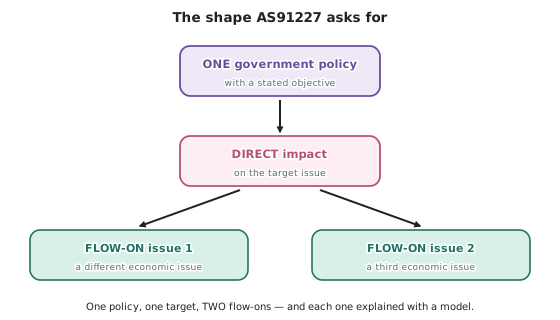
- One target. Two flow-ons. Required at Achieved.
What a flow-on effect is
- A flow-on effect is a consequence of the policy on an issue other than the one it was aimed at.
- It happens because the economy is connected: a policy that changes AD changes the price level, real GDP, employment and the exchange rate all at once, whether or not that was the intention.
- Flow-ons can be negative (unemployment rising when inflation is targeted) or positive (employment rising when growth is targeted).
The standard flow-on chains
Contractionary monetary policy (target: inflation)
- Growth: AD left → real GDP falls; falls, so future capacity grows more slowly. Negative.
- Unemployment: lower output → derived demand falls → DL left → unemployment rises. Negative.
- Trade: appreciation → exports dearer overseas, imports cheaper → falls, rises → balance worsens. Negative.
Expansionary fiscal policy (target: unemployment)
- Inflation: AD right → price level rises. Negative.
- Growth: real GDP rises; if the spending is infrastructure, capacity rises too. Positive.
- Trade: higher incomes → more imports → balance worsens. Negative.
A free trade agreement (target: international trade)
- Growth: rises → AD right; investment rises → capacity up. Positive.
- Inflation: domestic price of the exported good rises; but appreciation and cheaper imports push down. Mixed.
- Unemployment: export industries expand → derived demand rises → DL right. Positive.
Deregulation to raise supply in a market (target: resource allocation)
- Growth: AS right, PPF outward. Positive.
- Inflation: price falls in that market; if the market is heavily CPI-weighted, measured inflation falls. Positive.
- Environment / other: protections removed may impose costs. Potentially negative.
How to write a flow-on properly
Each flow-on needs the same four steps as the direct impact:
- Name the issue the flow-on lands on.
- Trace the chain from the policy to that issue, step by step.
- Put it on a model — and name the labels.
- Say whether it is positive or negative for that issue, and why.
"Flow-on to unemployment. The higher OCR reduced and , shifting AD left to AD1 and reducing real GDP from Y to Y1. Because firms are producing less, and labour demand is derived demand, their demand for labour falls: on the labour market model DL shifts left to DL1, reducing employment from Le to Le1. Unemployment therefore rises — a negative flow-on, and the main cost of using monetary policy to control inflation."
Choosing your two flow-on issues
- Pick issues where the chain is genuinely traceable, not merely plausible.
- The four macro issues — inflation, growth, unemployment, trade — connect to each other through AD, the exchange rate and derived demand, so any pair of them works.
- Do not choose an issue you cannot model. If you cannot draw a curve for it, you cannot meet the criterion.
Worked ExampleOne policy, one target, two flow-ons
Inflation is above the RBNZ's target band. The RBNZ raises the OCR.
Set out the direct impact and two flow-on effects in the structure the standard requires.
Step 1 — Objective and policy
Issue targeted: inflation. Objective: return annual CPI inflation to the 1–3% band set by the RBNZ's Remit. Policy: contractionary monetary policy — raise the OCR.
Step 2 — Direct impact on inflation
Higher OCR → banks raise mortgage, business lending and deposit rates → households spend less ( falls) and firms invest less ( falls) → AD shifts left from AD to AD1 → the price level falls from PL to PL1.
Reinforced by the exchange rate: higher rates attract overseas funds → demand for NZ$ shifts right → NZ$ appreciates → imported goods cheaper in the CPI, and AS shifts right through cheaper imported inputs.
The objective is achieved.
Step 3 — Flow-on 1: unemployment. Negative.
The same leftward AD shift reduces real GDP from Y to Y1.
Firms producing less need fewer workers. Because labour demand is derived demand, DL shifts left from DL to DL1, and employment falls from Le to Le1. The wage falls from We to We1.
On the PPF, the economy moves to a point inside its unchanged frontier — the workers exist and are not being used.
The unemployment created is cyclical, so it will reverse when the OCR is eventually cut — provided it does not last long enough for skills to decay, at which point it becomes structural and the PPF itself shifts inward.
Negative flow-on.
Step 4 — Flow-on 2: international trade. Negative.
The appreciation that helped reduce inflation makes New Zealand goods more expensive in foreign currency, so overseas buyers switch to cheaper suppliers and export volumes fall. Exporters also receive fewer NZ$ per unit of foreign currency earned, so export receipts ($X$) fall on both dimensions.
Meanwhile imports are cheaper, so New Zealanders buy more: import payments () rise.
Both movements worsen the balance on goods and services, and both reduce net exports — which shifts AD left again, reinforcing the disinflation but deepening the growth cost.
Inbound tourism, an export of services, is hit the same way.
Negative flow-on.
Step 5 — Summarise the structure
| Issue | Direction | Model used | |
|---|---|---|---|
| Direct | Inflation | Achieved — price level falls | AS/AD, market for NZ$ |
| Flow-on 1 | Unemployment | Negative — unemployment rises | Labour market, PPF |
| Flow-on 2 | International trade | Negative — balance worsens | Market for NZ$, AD |
Both flow-ons are negative, which is why the Excellence question — how to achieve the objective while minimising them — has something to work with.