Fiscal policy: spending and taxation
What fiscal policy is
- Fiscal policy is the government's use of spending and taxation to influence the economy.
- Decisions are made by the Government, advised by the Treasury, and announced in the annual Budget.
- Unlike monetary policy, it is not independent — it is set by elected ministers.
The two instruments
Government spending ()
- Infrastructure, health, education, defence, public sector wages, transfer payments.
- is a component of aggregate demand, so a change in it shifts AD directly.
Taxation
- Income tax, GST, company tax, excise duties.
- Taxation works indirectly: cutting income tax raises households' disposable income, which raises consumption ().
Expansionary fiscal policy
- Raise , or cut taxes, or both.
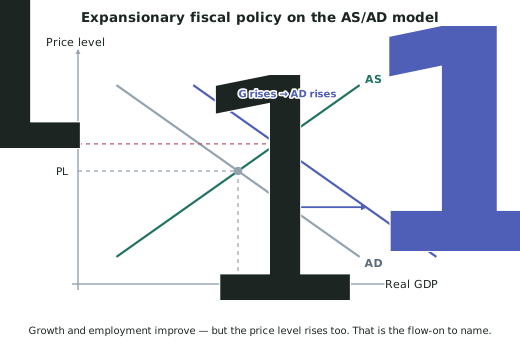
- Government spending rises, or taxes fall and households spend more.
- rises (or rises), so AD shifts right, from AD to AD1.
- Real GDP rises from Y to Y1 and the price level rises from PL to PL1.
- Firms produce more, so — through derived demand — they hire more workers and unemployment falls.
Contractionary fiscal policy reverses this: cut or raise taxes, AD shifts left, the price level and real GDP fall.
On the circular flow
- Government spending, transfer payments and subsidies are injections.
- Income tax and indirect taxes are leakages.
- Expansionary fiscal policy raises injections relative to leakages, so more money circulates and real GDP rises.
Fiscal policy can also be supply-side
- This is what distinguishes fiscal from monetary policy, and it matters for Excellence.
- Spending on infrastructure, education, training and R&D raises the economy's productive capacity:
- AS shifts right — real GDP rises and the price level falls
- the PPF shifts outward
- A supply-side fiscal policy raises growth without raising inflation, which is why it can escape the trade-offs that pure demand-side policy cannot.
The operating balance and debt
- Operating balance = revenue − expenditure.
- Expansionary fiscal policy worsens the operating balance in the short run: spending rises and/or tax revenue falls.
- A deficit must be financed by borrowing, which must be serviced later.
- But growth partly pays for itself: higher employment and incomes raise income tax, GST and company tax while cutting transfer payments, so the eventual cost is less than the headline figure.
Automatic stabilisers
- Some fiscal effects happen without any decision being made:
- In a downturn, tax revenue falls automatically (fewer people earning) and benefit payments rise automatically. Both support AD.
- In a boom, the reverse happens, restraining AD.
- Automatic stabilisers act immediately, which partly offsets fiscal policy's biggest weakness.
Strengths and weaknesses
| Strengths | Weaknesses |
|---|---|
| Targeted — can reach a specific region, sector or group | Slow — Budget cycle, consenting, construction |
| Can be supply-side, shifting AS right and the PPF outward | Hard to reverse politically |
| Automatic stabilisers act immediately | Worsens the operating balance; requires borrowing |
| Directly addresses distributional problems | Risk of arriving after the problem has passed |
Worked ExampleTwo fiscal policies, different flow-ons
The government wants to reduce unemployment. It considers two options:
Option A: a one-off cash payment to all households. Option B: a multi-year infrastructure programme.
Explain the direct impact of each on unemployment, and compare their flow-on effects on inflation and economic growth.
Step 1 — Option A: the direct impact on unemployment
The payment raises households' disposable income, so consumption () rises. AD shifts right, from AD to AD1.
Firms sell more, and because labour demand is derived demand, they need more workers: DL shifts right, employment rises from Le to Le1, and unemployment falls.
But the effect is short-lived. The payment is one-off, so once it is spent AD returns close to where it was, and the extra jobs may not last.
Step 2 — Option B: the direct impact on unemployment
Infrastructure spending raises directly, so AD shifts right. It also creates jobs directly — in construction, engineering and their supply chains — and those workers' incomes raise as a second round.
The effect is sustained, because the programme runs for several years.
Step 3 — Flow-on to inflation
Option A: inflationary. AD shifts right against an unchanged AS, so the price level rises from PL to PL1. If the economy is near capacity, most of the payment becomes higher prices rather than extra output, because there is little spare labour to draw on.
Option B: inflationary at first, then disinflationary. During construction, AD shifts right and the price level rises — and because construction competes for scarce building labour and materials, the pressure can be intense in that sector.
But once the infrastructure is completed, it is a capital good: better roads, ports and networks lower costs for every firm that uses them. AS shifts right, which lowers the price level while raising real GDP.
Step 4 — Flow-on to economic growth
Option A: a temporary rise. Real GDP rises from Y to Y1 while the money is being spent, then falls back. Productive capacity is unchanged — the PPF does not move, because nothing was built. Part of the payment also leaks into imports and savings, so the AD shift is smaller than the headline cost.
Option B: a temporary rise and a permanent gain. Real GDP rises during construction, and the finished infrastructure raises productive capacity permanently: the PPF shifts outward. Growth is higher not just during the programme but afterwards.
Step 5 — Compare and judge
| Option A | Option B | |
|---|---|---|
| Unemployment | Falls briefly | Falls for years |
| Inflation flow-on | Rises, no offset | Rises, then falls as AS shifts right |
| Growth flow-on | Temporary | Temporary plus permanent capacity |
| Speed | Immediate | Slow — consenting and construction |
| PPF | Unchanged | Shifts outward |
Option B is better on every dimension except speed. Option A's only advantage is that it can be delivered within weeks, which matters if the unemployment is a sudden cyclical shock.
The practical answer is a combination: Option A to support incomes immediately, and Option B to sustain employment and raise capacity — which is exactly the "combination of policies" reasoning the Excellence criterion asks for.