The circular flow model
What the model shows
- The circular flow model shows how money moves around the economy between five sectors.
- Every flow of money is matched by a flow of goods, services or resources in the opposite direction — the model draws the money flows.
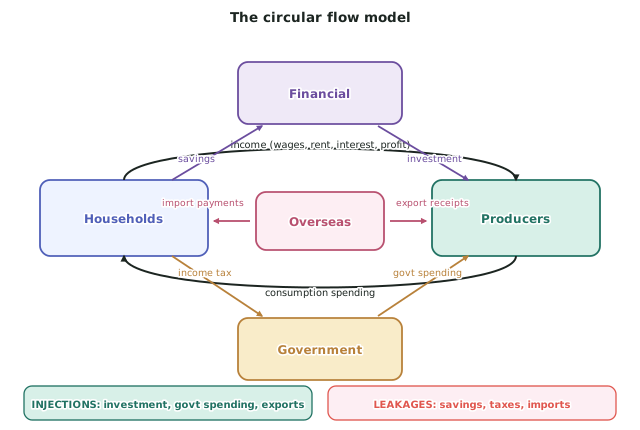
The five sectors
| Sector | What it does |
|---|---|
| Households | Own the resources (labour, land, capital) and spend on goods and services |
| Producers (firms) | Use resources to produce goods and services |
| Financial sector | Banks and other institutions that take savings and lend for investment |
| Government | Taxes, spends, and pays transfers and subsidies |
| Overseas | Buys New Zealand exports and sells imports to New Zealand |
The flows — learn these by name
Between households and producers (the inner loop)
- Income — wages, rent, interest and profit paid by producers to households for the use of their resources.
- Consumption spending — paid by households to producers for goods and services.
With the financial sector
- Savings — households put money into the financial sector. A leakage.
- Investment — the financial sector lends to producers to buy capital goods. An injection.
With the government
- Income tax — households pay the government. A leakage.
- Indirect taxes (GST) — producers pay the government. A leakage.
- Government spending — on goods, services and infrastructure. An injection.
- Transfer payments — superannuation and benefits paid to households. An injection.
- Subsidies — payments to producers. An injection.
With the overseas sector
- Export receipts — money flowing into New Zealand from overseas buyers. An injection.
- Import payments — money flowing out of New Zealand to overseas sellers. A leakage.
Injections and leakages
Injections put money into the circular flow: investment, government spending (including transfers and subsidies), and export receipts.
Leakages take money out: savings, taxes, and import payments.
| If… | The flow… | Economic growth |
|---|---|---|
| Injections > leakages | Grows | Rises |
| Injections = leakages | Is stable | Unchanged |
| Injections < leakages | Shrinks | Falls |
- Growth requires injections to exceed leakages. That is the whole model in one line.
How to answer a circular flow question
The paper always asks the same three things, in some order:
1. Identify a flow.
- Point to it and name it correctly: "Flow A is export receipts", "this is income tax".
2. Explain why a named flow rises or falls.
- Give the reason and name the sectors: "A new tourist attraction raises export receipts, because spending in New Zealand by overseas visitors is an export of services, so money flows from the overseas sector to producers."
3. Explain how the change raises or lowers growth, referring to two or more flows.
- This is where Merit is won. Follow the money round the loop.
The chain that earns Merit:
Export receipts rise → producers receive more money → they hire more workers and pay more income to households → households have more disposable income so consumption spending rises → producers receive still more → they invest in capacity → real GDP rises.
- Also name the government effects: more income and profits mean more income tax and GST, while fewer people need benefits, so transfer payments fall.
Worked ExampleFollowing the money round the loop
A new industry is established in a New Zealand region. It exports most of its output and employs several hundred local people.
Referring to the circular flow model, explain how this would increase economic growth in New Zealand. Refer to at least two flows in your answer.
Step 1 — Identify the first flow to change
The industry sells its output overseas, so overseas buyers pay New Zealand producers.
Export receipts rise. This is money flowing from the overseas sector to producers, and it is an injection into the circular flow.
Step 2 — Follow the money to households
Producers use that money to pay for the resources they employ.
Income rises. Wages, rent, interest and profit flow from producers to households — several hundred local workers now receive wages they did not have before.
Step 3 — Follow it back to producers
Households with higher incomes spend more in shops, cafés and services in the region.
Consumption spending rises. Money flows from households to producers, so firms across the region — not just the new industry — receive more revenue.
Step 4 — Note the second-round injection
Higher revenue and stronger expected demand make firms willing to expand.
Investment rises. The financial sector lends to producers to buy capital goods, which is another injection and also raises New Zealand's productive capacity.
Step 5 — Note the government flows
- Income tax rises, because more people are earning.
- Indirect taxes (GST) rise, because more is being spent.
- Transfer payments fall, because fewer people need unemployment benefits.
The first two are leakages that grow, and the third is an injection that shrinks — but the government's operating balance improves, because revenue rises while expenditure falls.
Step 6 — State the conclusion in the model's own terms
Injections have risen by more than leakages. Export receipts, investment and consumption have all increased, so more money is circulating and producers are producing more.