Real and nominal GDP
The concept the standard names
- The Explanatory Notes list "nominal and real GDP" as an examinable concept, and it appears in the paper most years.
Nominal GDP
- The value of output measured at the prices of the year in which it was produced — "current prices".
- It rises when prices rise, when output rises, or both. It cannot tell you which.
Real GDP
- The value of output with the effect of price changes removed — measured at the prices of a fixed base year, so it is "constant prices".
- It changes only when the quantity produced changes.
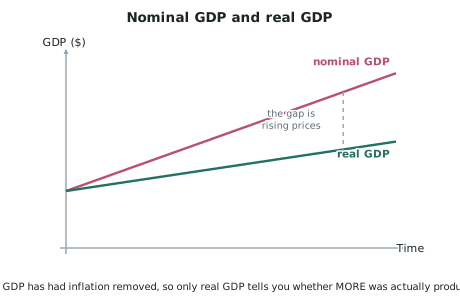
Why real GDP is the better measure of growth
- Economic growth means producing more, not charging more.
- If prices rise 5% and output does not change at all, nominal GDP rises 5% and the country is no better off — the same goods have simply been valued higher.
- Real GDP would show zero growth, correctly.
- So real GDP is the correct measure of economic growth, and nominal GDP is not.
Approximating the split
| Nominal GDP growth | Inflation | Real GDP growth | Interpretation |
|---|---|---|---|
| 8% | 3% | +5% | Strong genuine growth |
| 6% | 6% | 0% | All price, no extra output |
| 4% | 7% | −3% | Output actually fell |
| 2% | −1% | +3% | Output rose despite falling prices |
Limitations of real GDP as a measure
Even real GDP has weaknesses, and this is examined directly.
It ignores population
- A country whose real GDP rises 2% while its population rises 3% has less output per person than before.
- Real GDP per capita — real GDP divided by population — is the better measure of average material living standards.
It ignores distribution
- Real GDP can rise while the gains go to a small number of people and most households are no better off.
It ignores non-market production
- Unpaid childcare, care of the elderly and volunteering produce enormous real value and appear nowhere in GDP.
- A perverse consequence: if households start paying for childcare they previously did themselves, GDP rises even though no extra care is being provided.
It ignores the environment and resource depletion
- Cutting down a forest raises GDP by the value of the timber. The loss of the forest is not deducted.
It counts some things that are not gains
- Cleaning up after a disaster, treating illness caused by pollution and repairing crime damage all add to GDP.
It ignores leisure and working hours
- Producing the same output by working far longer hours raises no GDP, but people are worse off.
Worked ExampleSeparating price from output
A country's GDP figures are:
| Year | Nominal GDP | Price level index (base = 1000) |
|---|---|---|
| Year 1 | $340 billion | 1000 |
| Year 2 | $374 billion | 1100 |
(a) Calculate the percentage increase in nominal GDP. (b) Calculate real GDP in Year 2 at Year 1 prices, and the real growth rate. (c) Explain what the two answers together tell you about the economy.
Step 1 — (a) Nominal GDP growth
Nominal GDP rose 10.0%.
Step 2 — (b) Convert Year 2 to Year 1 prices
The price index rose from 1000 to 1100, so prices are 10% higher. To remove that, deflate Year 2's nominal figure:
Now compare with Year 1's real GDP, which is $340 billion (Year 1 is the base year, so its nominal and real figures are the same):
Real GDP growth is zero.
Step 3 — Check with the approximation
The approximation agrees with the exact calculation, as it should when the two rates are equal.
Step 4 — (c) What this tells you
The economy produced exactly the same quantity of goods and services in Year 2 as in Year 1. Every dollar of the $34 billion increase in nominal GDP was price, not production.
Anyone quoting the 10% nominal figure as "growth" would be describing inflation and calling it prosperity. There are no extra goods, no extra services, and — since output is unchanged — no reason to expect extra employment.