Net social welfare
The third measure the standard names
- The standard says economic growth means changes in real GDP, productive capacity, or net social welfare.
- Net social welfare is a broad measure of economic growth that combines economic indicators with quality of life indicators.
- The 2025 paper asked directly for a situation where GDP could increase but net social welfare decreases.
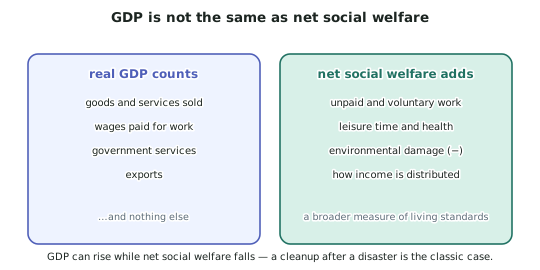
What net social welfare adds to GDP
Economic indicators it shares with GDP
- Real GDP or real GDP per capita
- Employment and unemployment
- Real incomes
Quality of life indicators it adds
- Health — life expectancy, infant mortality, access to healthcare
- Education — literacy, attainment, access
- Leisure — hours worked, holidays, time available outside work
- Environmental quality — air and water quality, biodiversity, greenhouse emissions (counted as a negative when they worsen)
- The distribution of income — whether the gains are widely shared or concentrated
- Unpaid work — childcare, care of the elderly, volunteering
- Safety and social conditions — crime rates, housing quality
When GDP rises and net social welfare falls
This is the examinable case. Learn two or three of these cold.
| Situation | GDP | Net social welfare |
|---|---|---|
| A new industry raises output but pollutes a river | Rises — output is sold | Falls — water quality, health and recreation lost |
| Output rises because people work much longer hours | Rises | Falls — leisure and family time lost |
| Growth is concentrated in a few high-income households | Rises | May fall — most people no better off, inequality up |
| Rebuilding after a disaster | Rises — construction is production | Falls — the disaster itself destroyed wellbeing |
| Congestion means longer commutes and more fuel sold | Rises — fuel and vehicles are bought | Falls — time lost, emissions up |
| Households start paying for childcare they used to do themselves | Rises — a transaction now exists | Unchanged — the same care is being provided |
| Depleting a fishery or forest faster than it regenerates | Rises now | Falls later — future capacity destroyed |
When they move together
- Most of the time, growth in real GDP does raise net social welfare:
- More output means more employment and higher incomes.
- Higher incomes and a larger tax base pay for health, education and superannuation.
- Richer countries can afford environmental protection that poor countries cannot.
- The disagreement is about how the growth was achieved and who received it — not about whether growth is generally good.
Sustainability
- Growth is sustainable if it can continue without destroying the resources future production depends on.
- Unsustainable growth borrows from the future: depleting soil, water, fisheries or forests raises real GDP now and reduces productive capacity later.
- Because productive capacity is one of the three things this standard defines growth as, environmental damage is a growth issue, not just an ethical one.
Worked ExampleGDP up, welfare down
Explain one situation in which New Zealand's GDP could increase while net social welfare decreases.
Step 1 — Choose a situation and be specific
A new industrial plant opens in a rural region. It processes a primary product, employs several hundred people, and discharges waste into the local river.
Step 2 — Why GDP rises
GDP is the total value of final goods and services produced in a year.
- The plant produces goods that are sold, and their value is counted in GDP.
- It pays wages to several hundred workers, raising incomes and household consumption.
- It buys inputs from local suppliers, raising their output too.
- If the product is exported, export receipts rise.
Real GDP therefore rises, and so does employment in the region.
Step 3 — Why net social welfare may fall
Net social welfare counts what GDP leaves out:
- Environmental quality falls. The river's water quality deteriorates. GDP records the value of the product sold and deducts nothing for the damage.
- Health may worsen for people using the river, and health is a quality-of-life indicator.
- Recreational and cultural value is lost. Swimming, fishing and mahinga kai are worth a great deal to the community and are not traded, so they are worth zero in GDP.
- Other industries lose. Tourism operators and downstream farmers may find the polluted river reduces their earnings — and, over time, the loss of clean water reduces New Zealand's productive capacity in those sectors.
- Distribution matters. The wages go to plant workers; the damage falls on everyone who lives near or uses the river, including people who gain nothing from the plant.
Step 4 — Bring it together
GDP rises because a marketed good was produced. Net social welfare may fall because something valuable but unpriced was destroyed.
Whether net social welfare rises or falls on balance depends on whether the value of the extra output and jobs exceeds the value of the environmental, health and recreational loss — and GDP does not even attempt that comparison.