The AS/AD model and economic growth
The same model, a harder question
- The AS/AD model works exactly as it does in AS91222 — but here the focus is real GDP (Y) rather than the price level, and the exam usually shifts both curves at once.
- Question stems in this standard read: "Explain each shift (aggregate supply and aggregate demand curves) shown in Graph One, and the impact on economic growth."
What raises economic growth on this model
A rightward shift of AD — more spending
- Rising consumer confidence, tax cuts or lower interest rates → rises
- Business confidence or cheaper borrowing → rises
- Infrastructure or service spending → rises
- Higher export receipts or a depreciation → rises
- Effect: real GDP rises and the price level rises.
A rightward shift of AS — cheaper or greater production
- New technology, better skills, cheaper inputs, more infrastructure
- Effect: real GDP rises and the price level falls.
Why both curves often shift together
- Many real events change both spending and capacity, and the exam picks those deliberately.
| Event | AD effect | AS effect |
|---|---|---|
| A major infrastructure project | Right — G rises during construction | Right — the finished asset raises productive capacity |
| A large increase in migrant workers | Right — more households consuming | Right — a larger workforce raises capacity |
| New capital investment by firms | Right — I rises now | Right — new machinery raises capacity later |
| A fall in the number of workers | Left — fewer households spending | Left — smaller workforce, less capacity |
| Better education and training | Little immediate effect | Right — more productive workers |
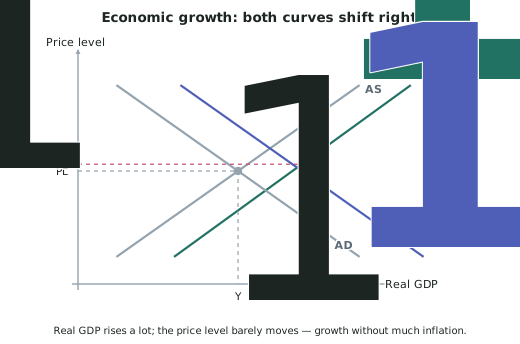
Reading a both-curves diagram
- When AD and AS both shift right:
- Real GDP rises strongly — both shifts push Y the same way.
- The price level barely moves — AD pushes PL up, AS pushes PL down, so they largely cancel.
- This is the best possible outcome: strong growth with little inflation. Say so.
- When AD and AS both shift left: real GDP falls sharply, and the price level is ambiguous.
Short run and long run
- Many growth events have opposite effects over different time horizons, and saying so is a strong Merit or Excellence move.
- Buying an expensive new asset: the purchase reduces short-term spending on other things — or, if the asset is imported, raises and reduces net exports — so AD falls in the short run. Operating the asset later raises capacity and consumption, so both curves shift right in the long run.
- Government spending funded by higher taxes: rises but falls, so the short-run AD effect is small; the infrastructure built raises capacity in the long run.
Worked ExampleBoth curves, two time horizons
A New Zealand airline purchases a fleet of new, more fuel-efficient aircraft from an overseas manufacturer. The aircraft are delivered and put into service the following year.
(a) Use the aggregate demand formula to explain why the purchase decreases short-term aggregate demand. (b) Explain the long-term impact of operating the new aircraft on aggregate supply and on economic growth.
Step 1 — (a) Start with the formula
The aircraft are bought from an overseas manufacturer, so the purchase is an import.
Step 2 — Identify the component that changes
Because is subtracted in the formula, a rise in reduces net exports and therefore reduces AD.
AD shifts left in the short run.
The money leaves the New Zealand circular flow as an import payment to the overseas sector, so it does not become income for New Zealand households or revenue for New Zealand producers. On the circular flow model this is a leakage.
Step 3 — (b) The long-term effect on aggregate supply
Once the aircraft are in service, they are more fuel-efficient than the fleet they replace. Fuel is one of an airline's largest costs, so its cost of production falls — it can fly the same routes for less.
Lower costs mean the airline is willing to supply more at every price level.
AS shifts right, from AS to AS1.
Step 4 — The effect on economic growth
Reading the new equilibrium where AS1 cuts AD:
- Real GDP rises from Y to Y1 — this is the economic growth.
- The price level falls from PL to PL1 — cheaper production means lower airfares.
Step 5 — The second-round effect on AD
Lower airfares mean New Zealanders and overseas visitors fly more.
- More overseas visitors means higher export receipts (), raising .
- Cheaper domestic travel raises consumption () on tourism and hospitality.
So AD shifts right in the long run too — and with both curves shifting right, real GDP rises strongly while the price level changes little.