Volumetric apparatus and correct technique
The three pieces of volumetric glassware
Each has one job, and using the wrong one for that job is a systematic error that no amount of repeating will fix.
| Apparatus | What it delivers | Typical uncertainty |
|---|---|---|
| Volumetric pipette | One fixed volume, very accurately (the aliquot) | ±0.06 mL on 20 mL |
| Burette | A variable volume, read as a difference (the titre) | ±0.05 mL per reading |
| Volumetric flask | Makes a solution up to one fixed total volume | ±0.2 mL on 250 mL |
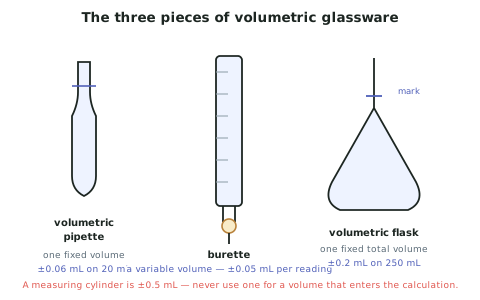
- A measuring cylinder has an uncertainty around ±0.5 mL — ten times worse. It is fine for the water you rinse with, and never for a volume that enters the calculation.
- A conical flask measures nothing. Its volume markings are decorative.
Setting up the titration
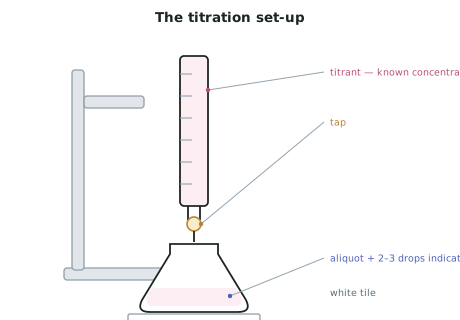
- Titrant (the standard solution of known concentration) goes in the burette.
- Aliquot (the measured sample of unknown concentration) goes in the conical flask, delivered by pipette.
- Indicator — two or three drops only — goes into the conical flask.
- A white tile under the flask makes the colour change visible.
Rinsing — the rule that catches everyone
Each piece of glassware is rinsed with something different, and the reasoning is the same each time: rinse with whatever solution will be in it, so that residual water cannot dilute it.
| Apparatus | Rinse with | Why |
|---|---|---|
| Burette | the titrant | water left inside would dilute the titrant, so a larger titre would be needed |
| Pipette | the solution being pipetted | water would dilute the aliquot, so a smaller titre would be needed |
| Conical flask | distilled water only | the amount of water present does not change the moles of substance in the aliquot |
| Volumetric flask | distilled water only | it is going to be filled to the mark with water anyway |
- The conical flask is the one students get wrong. Rinsing it with the sample solution adds extra moles of the substance being analysed and makes the titre too large — a systematic error every single time.
Reading the volumes
- Read the bottom of the meniscus for colourless solutions, at eye level, to the nearest 0.05 mL.
- For dark solutions such as permanganate, read the top of the meniscus, and be consistent.
- Record both the initial and final readings, not just the difference — the initial reading need not be 0.00 mL.
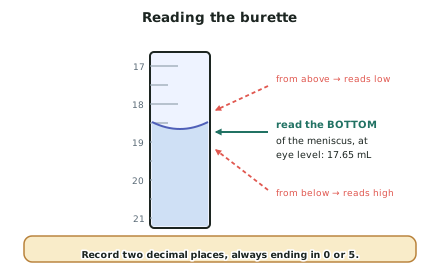
- Reading from above or below eye level causes parallax error, which shifts every reading in the same direction — a systematic error.
Running the titration
- Trial (rough) titration first — add titrant quickly to find the approximate endpoint.
- Then the accurate ones — run in quickly to about 1 mL before the rough value, then add dropwise.
- Swirl continuously so the reagents mix, otherwise the indicator changes locally and you stop early.
- Rinse the flask walls with distilled water near the endpoint, so any splashes are washed back in. This does not dilute the result, because the moles are unchanged.
- Stop at the first permanent colour change that lasts on swirling.
Concordant titres
- Concordant titres are those agreeing within ±0.05 mL of each other (some schools accept ±0.1 mL — use your teacher's rule and state it).
- Keep titrating until you have at least three concordant titres.
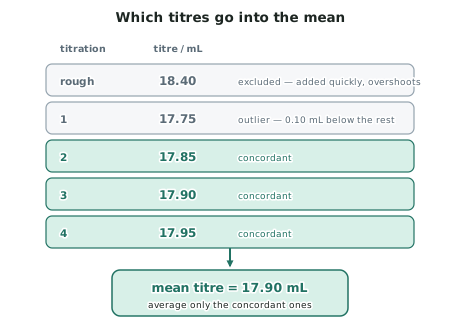
- Average only the concordant ones. The rough titration and any outlier are excluded from the mean.
Worked ExampleIdentifying the concordant titres
A student records the following titres: rough 18.40 mL, then 17.75 mL, 17.95 mL, 17.90 mL and 17.85 mL. Determine which titres are concordant and calculate the mean titre to be used in the calculation.
Step 1 — Exclude the rough titration
The rough titration (18.40 mL) is never included in the mean. Its purpose is only to locate the endpoint approximately, and it is always high because the titrant is added quickly and overshoots.
Step 2 — Look for a set agreeing within 0.05 mL
The four accurate titres are 17.75, 17.95, 17.90 and 17.85 mL.
Testing them against each other:
- 17.85, 17.90, 17.95 — the largest difference is mL. Taken as a group of three these span 0.10 mL, which is outside a strict ±0.05 mL rule but inside a ±0.1 mL rule.
- 17.75 sits 0.10 mL below the next nearest value and 0.20 mL below the highest. It is the clear outlier.
Using the common school convention that concordant titres lie within 0.1 mL of one another, the concordant set is 17.85, 17.90 and 17.95 mL, and 17.75 mL is excluded.
Step 3 — Calculate the mean
Step 4 — Note what to say about the outlier
The 17.75 mL titre should be reported, not deleted, with a comment: it was the first accurate titration after the rough one, and a low titre of this kind is typically caused by stopping at a transient colour change before the mixture was fully swirled.
Answer: the concordant titres are 17.85, 17.90 and 17.95 mL, giving a mean titre of 17.90 mL.