Back titration calculations
The idea in one line
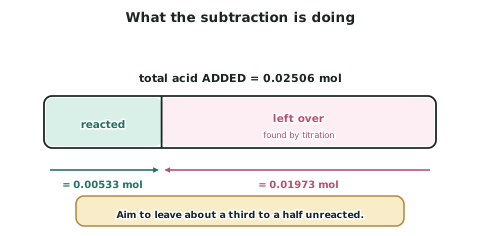
- You add a known excess of reagent, let it react completely, then titrate what is left over and subtract.
- Every back titration calculation is this subtraction wrapped in the ordinary titration steps.
When you need one
- The sample is an insoluble solid that reacts slowly — an antacid tablet, chalk, eggshell, limestone.
- The reaction has no sharp endpoint when done directly.
- The sample is volatile and would escape during a slow direct titration — ammonia is the classic case.
The full method
- 1. Add a measured volume of standard reagent A, in known excess, to the weighed sample.
- 2. React completely — warm and swirl, and wait until no more gas is evolved or all solid has dissolved.
- 3. Titrate the leftover A with standard reagent B.
- 4. Calculate moles of A added, and moles of A left over.
- 5. Subtract to get moles of A that reacted with the sample.
- 6. Apply the mole ratio between A and the substance in the sample.
The step everyone gets wrong
-
You need two different mole ratios, and they are easy to confuse:
- The ratio between A and B — used to find the leftover A from the titre.
- The ratio between A and the sample substance — used at the very end.
-
Write both balanced equations down before you start calculating, and label which ratio you are using at each step.
Checking your answer is sensible
-
The leftover moles must be less than the moles added. If your subtraction gives a negative number, either the titre or the added volume has been misread.
-
If the leftover is a very small fraction of what was added, the excess was barely enough — the reaction may not have gone to completion, and the answer will be too low.
-
If the leftover is nearly all of what was added, the excess was far too large — the difference between two big numbers has a large relative uncertainty, and the answer will be imprecise.
-
A well-designed back titration leaves roughly a third to a half of the added reagent unreacted.
Worked ExampleAntacid tablet by back titration
An antacid tablet with a mass of 1.482 g, containing calcium carbonate, was crushed and added to 50.0 mL of 0.5012 mol L−1 hydrochloric acid. The mixture was warmed until all the carbonate had reacted, then made up to 250.0 mL. A 25.0 mL aliquot of this solution required 19.65 mL of 0.1004 mol L−1 sodium hydroxide to neutralise the leftover acid.
Calculate the mass of calcium carbonate in the tablet, and its percentage by mass. (M(CaCO3) = 100.09 g mol−1)
Step 0 — Write both equations first
Acid with the sample:
Leftover acid with the titrant:
Step 1 — Moles of acid added
Step 2 — Moles of leftover acid, in the aliquot
The HCl : NaOH ratio is 1 : 1, so the aliquot contained:
Step 3 — Scale up to the whole 250.0 mL
The aliquot was 25.0 mL out of 250.0 mL, a factor of 10:
Step 4 — Subtract
Step 5 — Apply the sample's mole ratio
From the first equation, CaCO3 : HCl is 1 : 2, so the carbonate is half the reacted acid:
Step 6 — Convert to a mass and a percentage
Step 7 — Check the excess was sensible
Of the 0.02506 mol of acid added, 0.01973 mol remained — that is 79% left over, so only about a fifth of the acid was used. The excess was larger than ideal: the answer comes from the difference between two similar numbers, so the uncertainties in both contribute heavily to the uncertainty in that difference. Using about 25 mL of acid instead of 50 mL would have left a smaller, better-measured excess.
Answer: the tablet contains 0.267 g of calcium carbonate, which is 18.0% by mass.