The titration calculation, step by step
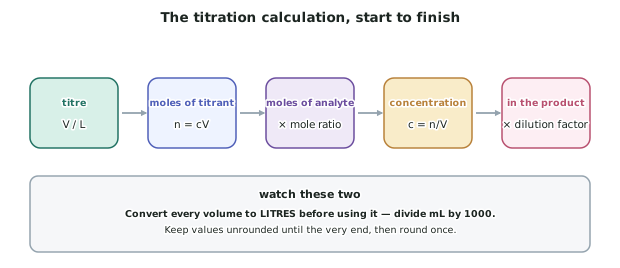
The route from titre to answer
Every titration calculation follows the same five steps, whatever the chemistry. Learn the route and you never have to think about where to start.
- 1. Moles of titrant — from the burette: .
- 2. Moles of the substance — from the mole ratio in the balanced equation.
- 3. Concentration in the flask — , using the aliquot volume.
- 4. Scale back — apply the dilution factor to get the original product.
- 5. Convert if needed — into g L−1, % by mass, or mg per tablet.
The relationships
-
— amount of substance, in mol
-
— concentration, in mol L−1
-
— volume, in L (always convert from mL by dividing by 1000)
-
— mass, in g
-
— molar mass, in g mol−1
-
The single most common arithmetic error in this standard is forgetting to convert mL to L. Every volume, every time.
The mole ratio step
-
Read the ratio straight from the balanced equation — the coefficients are the ratio.
-
For , the ratio HCl : Na2CO3 is 2 : 1.
- So , and .
-
Decide which way to multiply by asking which substance you have more of. If the ratio is 2 : 1 and you are going from the "1" to the "2", the number gets bigger.
-
Getting this step upside down gives an answer wrong by exactly a factor of 2 or 5, which is why it is worth pausing on.
Applying the dilution factor
-
The dilution factor is .
- 25.0 mL made up to 250.0 mL → factor 10.
- 10.0 mL made up to 500.0 mL → factor 50.
-
The concentration you calculate from the titre is that of the diluted solution. Multiply by the dilution factor to get the original.
-
Multiply, never divide. The original product is more concentrated than the diluted one, so the number must get bigger.
Converting to useful units
Consumer product labels rarely use mol L−1, so the last step usually converts:
| Wanted | How |
|---|---|
| g L−1 | |
| % by mass (m/v) | , for dilute aqueous solutions where 1 L ≈ 1000 g |
| mass per tablet | in the whole flask , divided by the number of tablets |
| mg per 100 mL |
Worked ExampleA complete titration calculation with a non-1:1 ratio
A student determines the concentration of ethanoic acid in vinegar. 25.0 mL of vinegar was diluted to 250.0 mL in a volumetric flask. 20.0 mL aliquots of the diluted vinegar were titrated with 0.1009 mol L−1 sodium hydroxide, giving a mean titre of 16.35 mL. Calculate the concentration of ethanoic acid in the original vinegar, in mol L−1 and in g L−1. (M(CH3COOH) = 60.05 g mol−1)
Step 1 — Moles of titrant used
Convert the titre to litres first: .
Step 2 — Moles of ethanoic acid, via the mole ratio
The equation is:
The ratio is 1 : 1, so:
Step 3 — Concentration in the diluted vinegar
The aliquot was 20.0 mL = 0.0200 L:
Step 4 — Scale back to the original vinegar
The dilution factor is:
Step 5 — Convert to g L−1
Step 6 — Sanity check
Vinegar is sold as about 4–5% ethanoic acid, which for a dilute aqueous solution is roughly 40–50 g L−1. The answer sits at the top of that range, which is consistent with a stronger vinegar.
Answer: 0.825 mol L−1, or 49.5 g L−1 — about 4.95% ethanoic acid by mass.
Note that this example uses a 1 : 1 ratio for clarity. Your own investigation must include at least one calculation with a non-1:1 ratio — see the back titration worked example on the next page.
Worked ExampleA calculation with a 2 : 1 mole ratio
A drain-cleaning product contains sulfuric acid. 10.0 mL of the product was diluted to 500.0 mL. 25.0 mL aliquots of the diluted solution required a mean titre of 21.40 mL of 0.1052 mol L−1 sodium hydroxide. Calculate the concentration of sulfuric acid in the original product.
Step 1 — Moles of titrant
Step 2 — Apply the mole ratio
Sulfuric acid is diprotic, so one mole of it neutralises two moles of hydroxide:
The ratio H2SO4 : NaOH is 1 : 2, so there is half as much acid as base:
Check the direction: we are going from the "2" to the "1", so the number should get smaller — and it did.
Step 3 — Concentration in the diluted solution
Step 4 — Scale back
The dilution factor is :
Step 5 — Significant figures
The titre (21.40 mL, 4 sf), the titrant concentration (0.1052, 4 sf) and the aliquot (25.0 mL, 3 sf) are the measured quantities. The least precise is 3 significant figures, so the answer is given to 3 sf.
Answer: the drain cleaner contains sulfuric acid at 2.25 mol L−1.