Preliminary trials and modifying the sample or procedure
Why a modification is nearly always needed
- A consumer product is designed to be used, not titrated. Almost every one presents at least one problem:
| Problem | Example product | Fix |
|---|---|---|
| Far too concentrated | vinegar, bleach, drain cleaner | Dilute a measured volume into a volumetric flask |
| Solid, not solution | antacid or vitamin C tablet | Weigh, crush and dissolve, making up to a known volume |
| Coloured | red wine vinegar, coloured mouthwash | Dilute heavily, or use a different indicator, or use a redox titration with a self-indicating titrant |
| Insoluble solid present | antacid with binders, chalky suspension | Filter, or use a back titration |
| Reacts slowly | calcium carbonate antacid | Back titration with excess acid, warmed |
| Unstable in air | vitamin C solution | Prepare fresh and titrate immediately |
- The standard asks you to decide whether modification is needed and what it should be. That decision must come from a preliminary trial, not from a guess.
What a preliminary trial is for
-
A preliminary trial is a quick, rough titration whose only purpose is to tell you whether your plan will work.
-
You are looking for answers to specific questions:
- How big is the titre? Under 10 mL or over 40 mL means something needs to change.
- Can you see the endpoint? If the product's own colour hides the indicator, you need a fix.
- Does everything dissolve? If not, you need filtering or a back titration.
- Is the endpoint sharp or gradual? A gradual fade means the wrong indicator.
-
Record the actual numbers and observations, including the ones that went wrong. They are the evidence for your modification.
The target: a titre of 15–25 mL
- Aim for a titre between about 15 and 25 mL in a 50 mL burette.
- Too small a titre (under 10 mL) means the fixed ±0.05 mL reading uncertainty on each reading is a large percentage of the result.
- A ±0.1 mL total uncertainty on a 5 mL titre is 2%; on a 20 mL titre it is 0.5%.
- Too large a titre (over 40 mL) risks refilling the burette mid-titration, which adds another pair of readings and another chance to make an error.
How to dilute properly
- Use a pipette to transfer an exact volume of the product into a volumetric flask, then make up to the mark with distilled water.
- Calculate the dilution factor and apply it at the end.
- 25.0 mL made up to 250.0 mL is a dilution factor of 10.
- The concentration you calculate is that of the diluted solution; multiply by 10 to get the original product.
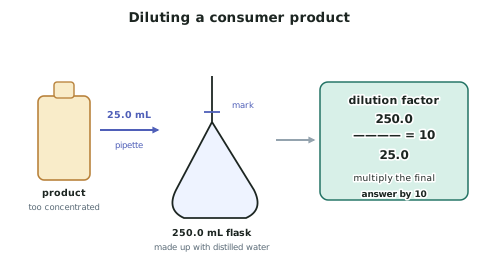
- Never dilute using a measuring cylinder or a beaker. Their uncertainty is ten to twenty times worse than volumetric glassware, and the whole point of the modification is to improve accuracy.
How to prepare a solid sample
-
Weigh the tablet or solid accurately on a 4-figure balance and record the mass to all decimal places shown.
-
Crush it to speed dissolving.
-
Dissolve completely, rinsing the mortar and any transfer glassware into the flask so no solid is lost.
-
Make up to the mark in a volumetric flask, then pipette aliquots from it.
-
Losing any solid during transfer is a systematic error that always makes the answer too low, so every rinse matters.
Back titration: when the direct route will not work
- A back titration is used when the substance reacts too slowly, is insoluble, or has no sharp endpoint with a direct titration.
- The method:
- Add a known excess of reagent A to the sample and let it react completely.
- Titrate the leftover reagent A with reagent B.
- Subtract: moles reacted with the sample = moles added − moles left over.
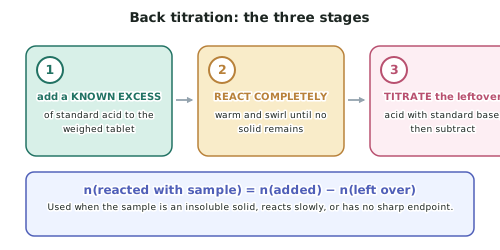
- Antacid tablets are the classic case: calcium carbonate is a solid that reacts slowly and would give a hopelessly vague endpoint titrated directly.
Worked ExampleDeciding on a modification from a trial
A student is determining the concentration of ethanoic acid in a supermarket vinegar by titration with 0.100 mol L−1 sodium hydroxide. In a preliminary trial, a 20.0 mL sample of undiluted vinegar required more than one full 50 mL burette of NaOH and the endpoint had still not been reached. Decide on a modification and justify it.
Step 1 — Read what the trial is telling you
The titre exceeded 50 mL and the endpoint was not reached, so the vinegar contains more than mol of acid in 20.0 mL — a concentration above 0.25 mol L−1, and evidently well above.
Household vinegar is about 4–8% ethanoic acid by mass, which is roughly 0.7–1.4 mol L−1. The trial is consistent with that.
Step 2 — Work out what titre the current plan would give
Taking the vinegar as about 0.8 mol L−1, a 20.0 mL aliquot contains:
Ethanoic acid and hydroxide react 1 : 1, so this needs 0.016 mol of NaOH:
That is more than three burette fillings — unworkable.
Step 3 — Choose the modification
To bring the titre to about 20 mL, the required volume must fall by a factor of about 8. The cleanest option is a tenfold dilution of the vinegar, which is easy to do exactly with standard glassware.
Method: pipette 25.0 mL of vinegar into a 250.0 mL volumetric flask and make up to the mark with distilled water.
Step 4 — Predict the new titre
The diluted vinegar is about mol L−1. A 20.0 mL aliquot then contains:
That sits inside the 15–25 mL target range.
Step 5 — Justify it
- Validity: the endpoint can now actually be reached and observed within a single burette filling, so a genuine equivalence point is being measured rather than estimated.
- Accuracy: at 16 mL, the ±0.1 mL total burette uncertainty is about 0.6% of the titre, compared with a much larger accumulated error from three refills. Using a pipette and volumetric flask for the dilution keeps the dilution factor itself accurate to about 0.2%.
Answer: dilute the vinegar by a factor of 10 (25.0 mL made up to 250.0 mL in a volumetric flask), which brings the expected titre to about 16 mL — inside one burette filling and in the range where the percentage reading error is smallest. Multiply the final concentration by 10 to obtain the concentration in the original vinegar.