Translations and reflections
The idea
- A transformation changes a graph's position, orientation or size without changing its family.
- Every transformation shows up as a change in the equation, and learning which change does what means you never have to plot points.
- The starting graph is called the parent function — , , and so on.
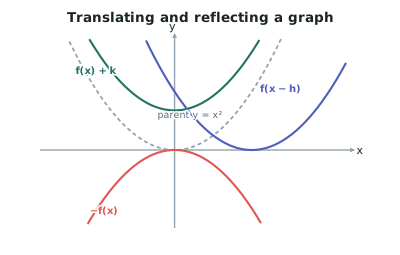
Vertical translations
- Moves the graph UP by (down if is negative).
- This one behaves as you expect: moves it up 3.
- is the parabola shifted up 5, so its vertex moves from to .
Horizontal translations
-
Moves the graph RIGHT by (left if is negative).
-
This one behaves the opposite way to how it looks. The minus sign inside gives a shift to the right.
- is shifted right 4
- is shifted left 4
-
Why it is "backwards". To get the same output as before, must now be larger by — so every point has moved right.
-
The reliable trick: ask what value of makes the bracket zero. For that is , and that is where the feature has moved to.
Combining both translations
-
Moves the graph right and up.
-
For a parabola this gives the vertex form with vertex at — the same rule you already know, now seen as a translation.
-
It works identically for every family:
- is the basic hyperbola moved right 2 and up 3, so its asymptotes move too, to and .
- is the exponential moved right 1 and up 4, so its asymptote becomes .
-
Asymptotes translate with the graph. This is the point students most often miss.
Reflection in the -axis
- Flips the graph upside down, over the horizontal axis.
- Every -value changes sign; -values are unchanged.
- is the parabola opening downwards.
- The -intercepts stay put (since is unchanged by the sign flip), but maxima become minima.
Reflection in the -axis
-
Flips the graph left-to-right, over the vertical axis.
-
Every -value changes sign; -values are unchanged.
-
is the exponential growth curve flipped into a decay curve.
-
The minus goes inside the function for a -axis reflection, and outside for an -axis reflection. Inside affects ; outside affects .
The general rule
- Changes OUTSIDE the function affect , and do what you expect.
- Changes INSIDE the function affect , and do the opposite of what you expect.
| Equation | Effect |
|---|---|
| up | |
| down | |
| right | |
| left | |
| reflect in the -axis | |
| reflect in the -axis |
Describing a transformation
- To describe how one graph relates to another:
- Identify the parent function.
- Compare the equations term by term.
- State each transformation with its direction and size.
- "The graph of is reflected in the -axis, then translated 3 right and 1 up."
- Order matters when a reflection is involved, so describe the reflection first if the minus applies to the whole function.
Worked ExampleDescribing and using a transformation
The graph of is reflected in the -axis, then translated 2 units left and 5 units up. Find the equation of the resulting graph, state its asymptotes, and find its -intercept.
Step 1 — Start from the parent function
The parent has asymptotes at and .
Step 2 — Apply the reflection in the -axis
A reflection in the -axis is — the minus goes outside:
This flips the branches into the second and fourth quadrants, but the asymptotes are unchanged at and , since both pass through the origin.
Step 3 — Apply the horizontal translation
"2 units left" means — the sign inside is the opposite of the direction:
Step 4 — Apply the vertical translation
"5 units up" means outside the function, and this one is not reversed:
Step 5 — Find the asymptotes
Vertical: set the denominator to zero:
Horizontal: as becomes large the fraction vanishes, leaving the constant:
Step 6 — Find the -intercept
Set :
-intercept:
Step 7 — State the domain and range
Taken straight from the asymptotes:
Step 8 — Check a transformed point
On the parent, lies on the curve. Applying the three transformations in order:
- Reflect:
- Left 2:
- Up 5:
Test in the final equation:
The point lands exactly where the transformations predict, confirming the equation.