Hyperbolas, asymptotes and domain and range
The basic hyperbola
- A reciprocal or hyperbolic function has the variable in the denominator:
- Its graph has two separate branches that never meet, sitting in opposite quadrants.
- The sign of decides which pair:
- — branches in the first and third quadrants
- — branches in the second and fourth
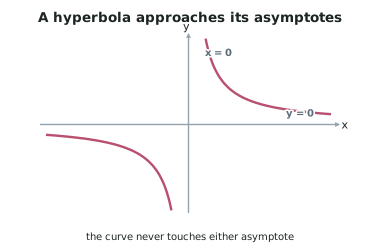
Asymptotes
-
An asymptote is a line the curve approaches ever more closely but never touches.
-
For :
- Vertical asymptote at — the function is undefined there, because you cannot divide by zero
- Horizontal asymptote at — as grows large, shrinks towards zero without reaching it
-
Always give an asymptote as an equation, such as , not as "the -axis" and never just as a dashed line.
The shifted hyperbola
-
The asymptotes move with the graph:
- Vertical asymptote: — found by setting the denominator to zero
- Horizontal asymptote: — the constant added on the outside
-
Watch the sign. has asymptotes at and ; has its vertical asymptote at .
-
To find the vertical asymptote of any rational function, set the denominator equal to zero and solve. That works whatever the numerator is.
Domain and range of a hyperbola
-
Domain: all real except where the denominator vanishes.
- For , the domain is .
-
Range: all real except the horizontal asymptote.
- The range is .
-
The excluded values are exactly the asymptotes. Once you have found the asymptotes, the domain and range follow immediately.
Domain and range across the families
- This is a named requirement of the standard — "properties of functions (may include domain and range)".
| Function | Domain | Range |
|---|---|---|
| Linear () | all real | all real |
| Quadratic, , vertex | all real | |
| Quadratic, | all real | |
| Cubic | all real | all real |
| Exponential () | all real | |
| Logarithm | all real | |
| Hyperbola | ||
- The pattern to notice: a domain restriction always comes from something you cannot do — divide by zero, take the log of a non-positive number, or take the square root of a negative.
Restricted domains in context
- In a modelling problem, the domain is usually limited by the situation, not by the algebra.
- If models a ball's height, the model applies only while the ball is in the air — so the domain is , even though the parabola itself is defined for all .
- Stating the practical domain is a Merit-level skill, and it shows you understand what the model does and does not describe.
Is it a function?
- A relation is a function if each -value gives exactly one -value.
- The vertical line test: if any vertical line crosses the graph more than once, it is not a function.
- Circles fail; parabolas, cubics, exponentials, logarithms and hyperbolas all pass.
Worked ExampleFull analysis of a shifted hyperbola
For , find both asymptotes, both intercepts, and the domain and range. Describe the graph.
Step 1 — Identify the family
The variable is in the denominator, so this is a hyperbola of the form
Comparing: , and since , we have and .
Step 2 — Find the vertical asymptote
Set the denominator to zero:
Vertical asymptote:
Step 3 — Find the horizontal asymptote
As becomes very large in either direction, shrinks towards zero, leaving:
Horizontal asymptote: — the constant on the outside.
Step 4 — Find the -intercept
Set :
-intercept: — the curve passes through the origin.
Step 5 — Find the -intercept
Set :
Multiply both sides by , valid since :
-intercept: — the same point, confirming the curve crosses both axes at the origin ✓
Step 6 — State the domain
The only forbidden input is the one that makes the denominator zero:
Step 7 — State the range
The only value can never take is the horizontal asymptote:
Step 8 — Describe the graph
Since , the branches sit in the "positive" pair of regions relative to the asymptotes:
- One branch is above and to the right of the asymptote crossing point : as the curve shoots up towards , and as it falls towards from above, passing through the origin on the way.
- The other branch is below and to the left: as the curve plunges towards , and as it rises towards from below.
Check a point on each branch.
- At : , which is above ✓ right branch
- At : , which is below ✓ left branch