Cubic, exponential and logarithmic graphs
Cubic graphs
- A cubic has as its highest power:
-
The characteristic shape has up to two turning points and passes from one corner of the plane to the opposite one.
-
The sign of decides the direction:
- — comes up from the bottom left, exits top right
- — comes down from the top left, exits bottom right
-
A cubic always crosses the -axis at least once, because it runs from to (or the reverse) and must pass through zero on the way.
Reading roots from factorised form
- Cubics are almost always given factorised, and that form hands you the roots:
- The -intercepts are , and .
- The -intercept is found by setting : .
Repeated roots change the shape
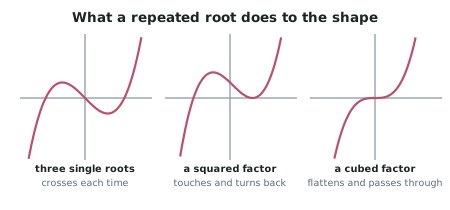
-
The multiplicity of a root determines the behaviour at that point:
- Single factor — the curve crosses the axis straight through
- Squared factor — the curve touches and turns back, like a parabola
- Cubed factor — the curve flattens and passes through with a horizontal tangent
-
crosses at and touches at .
-
This is a Merit-level distinction, and it lets you sketch accurately without any calculus.
Exponential graphs
- An exponential has the variable in the exponent:
-
Each part:
- — the -intercept, since
- — the base, which must be positive
-
The base decides the behaviour:
- — growth, rising steeply to the right
- — decay, falling towards the right
-
Key features of every exponential:
- A horizontal asymptote at — the curve approaches the -axis but never touches it
- No -intercept, for the same reason
- It is always positive (for ), so the range is
- The domain is all real
-
Note that exponentials grow far faster than polynomials. overtakes eventually, however large the power looks.
Logarithmic graphs
- A logarithm is the inverse of an exponential:
- The graph is the reflection of in the line , and every feature swaps over accordingly:
| Exponential | Logarithm | |
|---|---|---|
| Domain | all real | |
| Range | all real | |
| Asymptote | horizontal, | vertical, |
| Intercept | -intercept at 1 | -intercept at 1 |
- The domain restriction is the thing to remember. of zero or a negative number does not exist, so the curve exists only to the right of the -axis.
- It rises steeply at first, then flattens off — but it keeps rising forever, never reaching a ceiling.
Circles
- A circle centred on the origin with radius :
- Centred at :
- A circle is not a function — it fails the vertical line test, since most -values give two -values.
Absolute value
- is a V shape with its point at the origin.
- It takes the positive version of whatever is inside: .
- moves the point to , using the same translation rules as any other graph.
Worked ExampleSketching a cubic from factorised form
Sketch , marking all intercepts and describing the behaviour at each.
Step 1 — Identify the family and direction
Expanding would give an term, so this is a cubic.
The leading coefficient. The highest-power term comes from multiplying the from each bracket, including the squared one:
So : the curve comes down from the top left and exits bottom right.
Step 2 — Find the -intercepts
Set . A product is zero when any factor is zero:
There are only two distinct intercepts, even though a cubic has three roots — because is a repeated root.
Step 3 — Determine the behaviour at each root
At : the factor appears to the power 1 — an odd multiplicity — so the curve crosses straight through the axis.
At : the factor appears to the power 2 — an even multiplicity — so the curve touches the axis and turns back, like the vertex of a parabola.
Step 4 — Find the -intercept
Set :
-intercept:
Step 5 — Determine the sign in each region
Test a value in each interval to know whether the curve is above or below the axis:
- : — above the axis
- : — below the axis
- : — below the axis
Note the sign does not change at , which confirms the touch-and-turn behaviour there ✓
Step 6 — Describe the sketch
The curve:
- comes down from the top left, above the axis
- crosses the -axis at , moving below it
- passes through the -intercept
- rises to touch the -axis at without crossing
- turns back downwards and falls away to the bottom right
Step 7 — Sense-check
A cubic with a negative leading coefficient must end at the bottom right — and it does ✓ The touch at means the curve has a local maximum exactly on the axis there, which is consistent with the sign staying negative on both sides.