Resonance
Natural frequency
- Every system that can oscillate has one or more natural frequencies — the frequencies at which it will vibrate if disturbed and then left alone.
- For a string or a pipe, the natural frequencies are exactly the harmonic frequencies worked out on the previous pages.
- The natural frequency is set by the properties of the system — its length, tension, mass, or the speed of waves in it — not by whatever is driving it.
What resonance is
-
Resonance occurs when a system is driven by a periodic force at one of its natural frequencies.
-
Energy is then transferred into the system in step with its oscillation — each push arrives at the right moment to add to the motion rather than oppose it.
-
The result is a large increase in amplitude, building up over many cycles.
-
Away from a natural frequency, the driving force falls out of step: sometimes it pushes with the motion and sometimes against it, so the energy transferred over a cycle is small and the amplitude stays low.
-
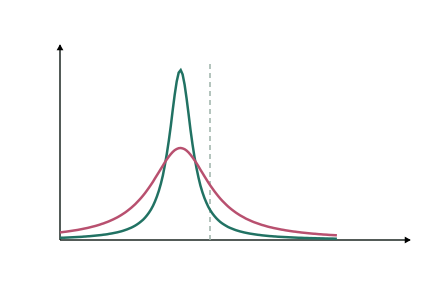
A graph of amplitude against driving frequency therefore shows a sharp peak at each natural frequency — the resonance curve.
The conditions for resonance
All three must hold:
- there must be a periodic driving force,
- its frequency must match a natural frequency of the system,
- the system must be able to oscillate and be lightly damped enough for the amplitude to build.
Damping
- Damping is any process that removes energy from the oscillation — friction, air resistance, or deliberate absorption.
- Increasing the damping:
- lowers the height of the resonance peak,
- broadens it, so resonance occurs over a wider range of frequencies,
- shifts the peak very slightly to a lower frequency.
- Heavy damping can suppress resonance almost entirely, which is precisely why it is engineered into structures that must not resonate.
Resonance in practice
Useful:
- Musical instruments — a string or air column is driven at a natural frequency and resonates loudly; the instrument body resonates too, amplifying the sound.
- A resonance tube used in the laboratory to measure the speed of sound: the air column length is adjusted until the sound is loudest, which locates a natural frequency.
- Microwave ovens, MRI scanners and radio tuning circuits all rely on driving a system at its natural frequency.
A problem:
- Bridges and buildings — wind or marching feet supplying a periodic force at a natural frequency can build dangerous amplitudes, which is why soldiers break step on bridges and why tall buildings contain tuned mass dampers.
- Vehicles — a rattle that appears only at one particular engine speed is a component being driven at its natural frequency.
- Wine glass shattered by a voice — driven at the glass's natural frequency, the amplitude grows until the material fails.
Worked ExampleMeasuring the speed of sound with a resonance tube
A tube closed at one end is lowered into water so that its air column length can be varied. A tuning fork of frequency Hz is held over the open end. The sound is loudest when the air column is cm long, and again when it is cm long. Find the speed of sound in the air column.
Step 1 — Identify what "loudest" means
The sound is loudest at resonance, which occurs when the air column length matches a natural frequency of the closed pipe for that driving frequency.
Step 2 — Identify the two resonances
For a closed pipe the resonant lengths are at , , , … The first two resonances are therefore:
Step 3 — Use the difference between them
Subtracting removes the end correction (the antinode sits slightly outside the open end), which is why using two resonances is better than one:
Step 4 — Speed of sound
Worked ExamplePredicting whether resonance will occur
A wire fixed at both ends is m long, and waves travel along it at m s−1. It is placed near a loudspeaker that can be set to any frequency. State which of the following driving frequencies will cause resonance: Hz, Hz, Hz, Hz.
Step 1 — Find the natural frequencies of the wire
The wire is fixed at both ends, so:
Step 2 — List the harmonic series
A string carries all harmonics, so its natural frequencies are:
Step 3 — Test each driving frequency
- Hz — not a multiple of . No resonance.
- Hz — the fundamental. Resonance.
- Hz — not a multiple of . No resonance.
- Hz — this is , the third harmonic. Resonance.