Two-slit interference and path difference
The set-up
-
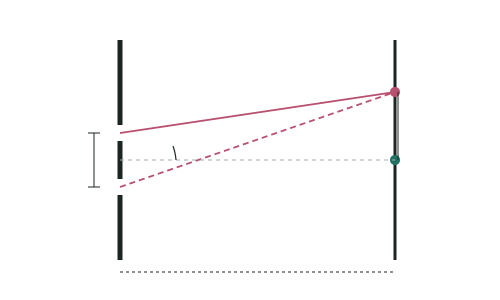
Light (or sound) from a single source is passed through two narrow, closely spaced slits.
-
Each slit diffracts the wave, so it spreads out beyond the slit and the two spreading waves overlap.
-
Where they overlap they superpose, producing a pattern of alternating bright and dark fringes on a screen.
-
The two slits must be illuminated by the same source so that they are coherent — the same frequency and a constant phase relationship.
- Two separate lamps would not work: their phase relationship changes randomly millions of times per second, so the pattern would shift too fast to see and would average out to uniform brightness.
- A laser is coherent to begin with, which is why modern demonstrations use one.
Path difference decides everything
- The two waves leave the slits in phase, but they travel different distances to reach a given point on the screen.
- The path difference is how much further one wave has travelled than the other.
-
— the order of the fringe,
-
A path difference of a whole number of wavelengths puts the two waves back in phase, so they reinforce.
-
A path difference of a half number of wavelengths puts them exactly out of phase, so they cancel.
The central fringe
- The point on the screen directly opposite the midpoint of the two slits is equidistant from both.
- The path difference there is zero, which is a whole number of wavelengths (), so it is always a bright fringe.
- This central maximum is the brightest fringe and the reference point from which orders are counted outward: is the first bright fringe either side of it, the next, and so on.
Move the sources and change the wavelength below to watch the fringe pattern respond:
Path difference = 0.53 λ → destructive (dark)
Drag the detector.
Why the slits must be narrow and close together
- Narrow slits are needed so each one diffracts strongly. If the slits are wide compared with the wavelength, the light barely spreads and the two beams never overlap enough to interfere.
- Closely spaced slits are needed so the fringes are far enough apart to see. As the next page shows quantitatively, fringe spacing is inversely proportional to slit separation.
- For visible light ( m) this means slit separations of a fraction of a millimetre — which is why the effect was not observed until Young's careful experiment in 1801, and why it was such strong evidence that light is a wave.
Interference of sound
- The same physics applies to sound, using two loudspeakers driven by one signal generator in place of two slits.
- Walking across in front of them, a listener passes through alternating loud and quiet positions — the audible equivalent of bright and dark fringes.
- Sound's much longer wavelength (metres, rather than fractions of a micrometre) means the "slits" can be metres apart and the pattern is spread across a room.
Worked ExampleIdentifying a fringe from a path difference
In a two-slit experiment with light of wavelength nm, a point on the screen is m further from one slit than from the other. Determine whether this point is bright or dark, and state its order.
Step 1 — Express the path difference in wavelengths
Step 2 — Interpret
The path difference is exactly 4 wavelengths — a whole number.
The wave from the further slit has fallen behind by exactly four complete cycles, which puts it back in phase with the other. The two therefore reinforce.
Step 3 — State the result
Worked ExampleFinding the wavelength from a dark fringe
Two loudspeakers, driven together at a single frequency, face a room. A listener stands at a point that is m from one speaker and m from the other, and finds it is the first quiet position away from the centre. Find the wavelength of the sound, and its frequency if the speed of sound is m s−1.
Step 1 — Path difference
Step 2 — Apply the destructive condition
The first quiet position corresponds to in the destructive condition, so the path difference is half a wavelength:
Step 3 — Frequency