The Doppler effect
What it is
-
The Doppler effect is the change in the observed frequency of a wave when the source is moving relative to the observer.
-
The classic example is the pitch of a siren: higher as the vehicle approaches, lower as it recedes, with an abrupt drop as it passes.
-
At Level 3 this standard is limited to a stationary observer and a moving source, and to mechanical waves such as sound. The moving-observer case and the relativistic (light) Doppler effect are not assessed.
Why the frequency changes
The mechanism is not that the waves speed up or slow down. It is that the source moves between emitting successive wavefronts:
- The source emits a wavefront, then travels a short distance forward before emitting the next.
- Ahead of the source, each new wavefront is emitted closer to the previous one, so the wavefronts are bunched together — the wavelength is shortened.
- Behind the source, each new wavefront is emitted further from the previous one, so the wavefronts are stretched apart — the wavelength is lengthened.
- The waves travel through the medium at the same speed regardless, so from :
- shorter wavelength ahead → higher observed frequency,
- longer wavelength behind → lower observed frequency.
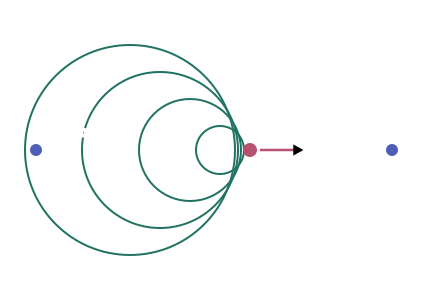
Move the source below and watch the wavefronts bunch and stretch:
Ahead 2.80f₀ · behind 0.93f₀
f′ = f · v/(v ∓ v_source)
Three things that do not change
Stating these correctly is often worth a mark on its own:
- The speed of the waves is unchanged. It is a property of the medium (the air), not of the source, so it is the same ahead of and behind the source.
- The frequency emitted by the source is unchanged. The siren is doing exactly the same thing throughout; it is the observed frequency that differs.
- The amplitude is not what changes the pitch. A sound getting louder as a vehicle approaches is a separate effect (the observer is closer) and has nothing to do with the Doppler shift.
What the observer hears
- Approaching: observed frequency is higher than emitted (). It stays constant while the source approaches at constant speed — it does not rise gradually.
- At the instant of passing: the observed frequency drops suddenly to the emitted value and then below it.
- Receding: observed frequency is lower than emitted (), again constant while the speed is constant.
- So the sound of a passing siren is two steady pitches with a sharp drop between them, not a continuous slide. Recognising this is a common exam question.
Applications
- Doppler radar and speed cameras — the shift in a reflected wave gives the speed of a vehicle.
- Medical ultrasound — the shift from moving blood cells measures blood flow speed and direction.
- Weather radar — measures the speed of rain and wind within a storm.
- Astronomy — light from receding galaxies is shifted to longer wavelengths (redshift), which is the primary evidence that the universe is expanding. This uses the relativistic Doppler effect, which is beyond this standard, but the underlying idea is the same.
Worked ExampleExplaining the wavefront pattern
A police car with its siren sounding drives past a stationary observer at constant speed. Describe and explain what the observer hears, referring to the wavefronts.
Step 1 — While the car approaches
The siren emits wavefronts at a constant rate. Between emitting one wavefront and the next, the car moves forward, so the next wavefront starts from a point closer to the previous one in the forward direction.
The wavefronts ahead of the car are therefore bunched together: the wavelength reaching the observer is shorter than the wavelength the siren emits.
The speed of sound is unchanged — it is set by the air — so from , a shorter wavelength gives a higher observed frequency. The observer hears a pitch higher than the siren's true pitch, and it stays constant as long as the car's speed is constant.
Step 2 — At the moment of passing
As the car passes, the direction from car to observer swings round from “ahead” to “behind”. The observed frequency therefore drops abruptly through the true emitted frequency and continues below it.
Step 3 — While the car recedes
Now each wavefront is emitted further from the previous one in the observer's direction, so the wavefronts are stretched apart: the wavelength reaching the observer is longer than that emitted.
Again the wave speed is unchanged, so the observed frequency is lower than the true frequency, and again it is constant while the speed is constant.