How standing waves form
Superposition of a wave and its reflection
-
A standing wave (or stationary wave) forms when two waves of the same frequency and amplitude travel in opposite directions through the same medium and superpose.
-
In practice the second wave is almost always the reflection of the first from a boundary — the end of a string, or the end of a pipe.
-
The result is a pattern that stays in place instead of travelling. This is what the name means.
-
Node — a point of zero amplitude. The two waves always arrive out of phase there and cancel completely, so the medium never moves.
-
Antinode — a point of maximum amplitude. The two waves always arrive in phase there and reinforce, so the medium swings through the largest displacement.
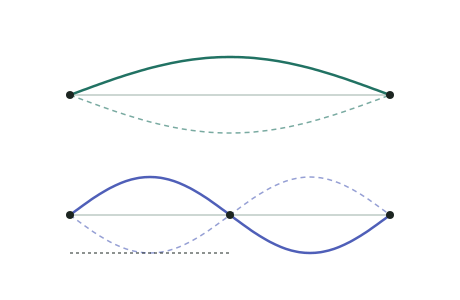
The geometry you must know
- Adjacent nodes are half a wavelength apart:
- Adjacent antinodes are also half a wavelength apart.
- A node and its neighbouring antinode are a quarter wavelength apart:
- These three facts, plus what the ends of the system force, generate every harmonic formula in this topic. You do not need to memorise the formulas if you can sketch the pattern.
Pick a harmonic below and press Play. The pink dots are nodes — they never move — and the blue dots are antinodes, swinging with the largest amplitude:
2 loops · wavelength λ = 1.00 L · 3 nodes
Drag across to scrub.
Standing waves compared with travelling waves
| Travelling wave | Standing wave | |
|---|---|---|
| Does the pattern move? | Yes — it advances | No — it stays in place |
| Amplitude | the same at every point | varies with position: zero at nodes, maximum at antinodes |
| Phase | changes continuously along the wave | all points in one loop are in phase; adjacent loops are antiphase |
| Energy | transferred along the wave | stored, oscillating between kinetic and potential |
| Wavelength | distance between adjacent crests | twice the node-to-node distance |
- The energy point is worth stating in explanation answers: a standing wave does not transfer energy along the medium, because the two component waves carry equal energy in opposite directions. The energy sloshes between kinetic and potential within each loop.
What every point is doing
- All points between two adjacent nodes (within one "loop") move in phase — they reach their maximum displacement at the same instant and pass through zero together.
- Points in adjacent loops are completely out of phase — as one loop swings up, the next swings down.
- Every point in the pattern passes through the flat line at the same instant, twice per cycle. At that moment the whole string looks straight and all the energy is kinetic.
- A moment later the string reaches maximum displacement everywhere at once, and all the energy is potential.
Worked ExampleFinding the wavelength from a pattern
A standing wave on a stretched string m long shows four loops between its two fixed ends. The frequency of the vibration is Hz. Find the wavelength and the speed of the waves on the string.
Step 1 — Relate the loops to the wavelength
Each "loop" is the section between two adjacent nodes, so each loop is half a wavelength long.
Four loops in m means:
Step 2 — Find the wave speed
Worked ExampleReasoning from node positions
On a long string, adjacent nodes of a standing wave are found to be m apart. The waves travel at m s−1. Find the wavelength and the frequency, and state the distance from a node to the nearest antinode.
Step 1 — Wavelength from the node spacing
Adjacent nodes are half a wavelength apart:
Step 2 — Frequency
Step 3 — Node to antinode
An antinode sits midway between two nodes, so it is a quarter wavelength from each: