Uniform electric fields and field strength
What an electric field is
- An electric field is a region in which a charge experiences a force.
- It is a vector — it has a direction at every point.
- The direction of the field is defined as the direction of the force on a positive charge.
- So field lines point away from positive charges and toward negative ones.
The uniform field between parallel plates
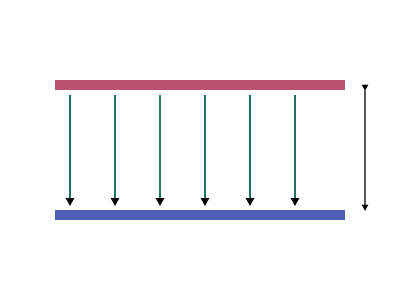
- Two flat parallel plates connected to a power supply produce a uniform field in the gap between them.
- Uniform means the field has the same strength and the same direction at every point in the gap.
- On a diagram it is drawn as evenly spaced parallel field lines, running from the positive plate to the negative plate.
- Even spacing is what shows the field is uniform — lines that fan out or bunch up would mean a changing strength.
- The lines are always perpendicular to the plates.
- At Level 2 you only deal with the uniform field. The field of a single point charge, which weakens with distance, is Level 3.
Electric field strength
-
— electric field strength (V m−1, which is the same unit as N C−1)
-
— the voltage (potential difference) between the plates (V)
-
— the separation of the plates (m)
-
The two units are genuinely equivalent: field strength is both "volts per metre of gap" and "newtons of force per coulomb of charge".
-
The relationship says:
- more voltage across the same gap → stronger field,
- a wider gap at the same voltage → weaker field, because the same potential difference is spread over more distance.
-
is the plate separation, not the distance the charge has moved and not the length of the plates.
Drag the charge around the gap below. The field lines stay evenly spaced and parallel, so the force is the same size and direction wherever you put it — that is what uniform means. Change the voltage or the plate spacing and watch respond:
E = V/d = 200/0.04 = 5,000 V/m
F = qE = 10.00 mN (same everywhere)
What changes the field and what does not
| Change | Effect on |
|---|---|
| Double the voltage | Doubles |
| Double the plate separation | Halves |
| Move the charge to a different point in the gap | No change — the field is uniform |
| Use a bigger charge | No change — depends only on the plates |
- This last row matters: the field is a property of the plates, not of whatever you put between them. The charge only comes in when you calculate the force on it.
Worked ExampleField strength between plates
Two parallel plates are mm apart with a potential difference of V across them. Find the electric field strength between them, and state its direction.
Step 1 — Convert the separation to metres
Step 2 — Apply the field relationship
Step 3 — Direction
The field points from the positive plate toward the negative plate, perpendicular to both.
Worked ExampleWorking back to a plate separation
A uniform field of strength V m−1 is required between two plates connected to a V supply. How far apart must the plates be?
Step 1 — Rearrange
Step 2 — Substitute