Parallel circuits
What a parallel circuit is
- Components in parallel are connected across each other, providing separate paths for the charge.
- Each path is called a branch.
- If one branch breaks, the others keep working — the charge simply takes the remaining paths.
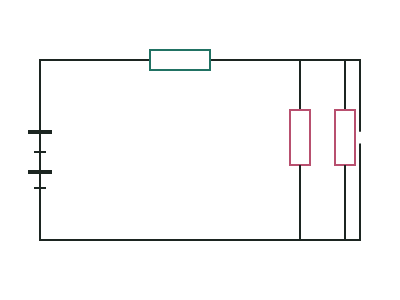
The three rules
Voltage is the same across every branch.
- Every branch is connected directly across the same two points, so each experiences the full supply voltage.
Currents add up to the total.
- The current splits at the junction and recombines afterward.
- This is conservation of charge: nothing is lost at the junction.
- The branch with the smallest resistance takes the largest current, because they all have the same voltage across them and .
Resistances combine as reciprocals.
- The total resistance is always smaller than the smallest individual resistance.
- This is the result students find most surprising, and it is worth understanding rather than memorising: adding another branch gives the charge an extra route, making it easier for current to flow overall.
- For exactly two resistors there is a useful shortcut:
- For identical resistors of resistance : .
Build parallel and series combinations below and compare the currents in each branch:
Total R = 6.00 Ω · supply current 2.00 A
Series: same current everywhere; the supply voltage splits between the resistors.
Consequences worth knowing
- Adding another branch lowers , so the total current drawn from the supply increases.
- Existing branches are unaffected — they still have the full supply voltage across them and the same current as before.
- This is exactly why household wiring is parallel: switching on a jug does not dim the lights, and each appliance gets the full V.
- Each appliance can be switched independently, and one failure does not stop the rest.
Worked ExampleTwo resistors in parallel
A V supply is connected across a Ω resistor and a Ω resistor in parallel. Find the total resistance, the current in each branch, and the total current.
Step 1 — Total resistance
This is less than Ω, the smaller branch — the check passes.
Step 2 — Current in each branch
Each branch has the full V across it:
Step 3 — Total current
Step 4 — Check against the total resistance
Worked ExampleAdding a branch
A V supply drives a single Ω resistor. A second Ω resistor is added in parallel. Find the total current before and after, and state what happens to the current in the original resistor.
Step 1 — Before
Step 2 — After: new total resistance
Two identical resistors in parallel:
Step 3 — Current in the original resistor
It still has the full V across it, so: